
Bible verses and what the Bible says
Psalm 139 meaning, verse by verse
Psalm 139 is a prayer about being completely known: God knows every thought and step, is present everywhere from the heights to the depths and the darkest night, and formed the writer in the womb, which is why it ends by inviting God to search the heart and lead it in the everlasting way.
Psalm 139, the whole psalm
“LORD, you have searched me, and you know me. You know my sitting down and my rising up. You perceive my thoughts from afar. You search out my path and my lying down, and are acquainted with all my ways. For there is not a word on my tongue, but behold, LORD, you know it altogether. You hem me in behind and before. You laid your hand on me. This knowledge is beyond me. It’s lofty. I can’t attain it.”
Psalm 139:1-6
Known completely: God knows when I sit and rise, my thoughts, my path and every word before I say it. Such knowledge is too wonderful to grasp.
“Where could I go from your Spirit? Or where could I flee from your presence? If I ascend up into heaven, you are there. If I make my bed in Sheol, behold, you are there! If I take the wings of the dawn, and settle in the uttermost parts of the sea, even there your hand will lead me, and your right hand will hold me. If I say, “Surely the darkness will overwhelm me. The light around me will be night,” even the darkness doesn’t hide from you, but the night shines as the day. The darkness is like light to you.”
Psalm 139:7-12
Nowhere God isn't: the heavens, the grave, the far side of the sea. Even darkness is not dark to God; night shines like day.
“For you formed my inmost being. You knit me together in my mother’s womb. I will give thanks to you, for I am fearfully and wonderfully made. Your works are wonderful. My soul knows that very well. My frame wasn’t hidden from you, when I was made in secret, woven together in the depths of the earth. Your eyes saw my body. In your book they were all written, the days that were ordained for me, when as yet there were none of them.”
Psalm 139:13-16
Made with care: formed and knit together in the womb, fearfully and wonderfully made, every day written before it came to be.
“How precious to me are your thoughts, God! How vast is their sum! If I would count them, they are more in number than the sand. When I wake up, I am still with you.”
Psalm 139:17-18
God's thoughts are precious and countless, more than the sand, and when I wake I am still with God.
“If only you, God, would kill the wicked. Get away from me, you bloodthirsty men! For they speak against you wickedly. Your enemies take your name in vain. LORD, don’t I hate those who hate you? Am I not grieved with those who rise up against you? I hate them with perfect hatred. They have become my enemies.”
Psalm 139:19-22
The hard section: the writer's raw anger at people who do violence and speak against God.
“Search me, God, and know my heart. Try me, and know my thoughts. See if there is any wicked way in me, and lead me in the everlasting way.”
Psalm 139:23-24
The closing prayer: search me, know my heart, see if there is any offensive way in me, and lead me in the everlasting way.
Bible quotations are from the World English Bible (British Edition), which is in the public domain.
A prayer you can pray
A prayer from Psalm 139
God, you know me better than I know myself: when I sit and when I rise, what I'm thinking and what I'm about to say. Thank you that I can't hide from you, and that I don't need to.
Thank you for making me, body and mind, with care. On days I don't like what I see, help me to see what you see.
Search my heart. Show me what needs to change, and lead me in your way. Amen.
Why do people turn to Psalm 139?
Psalm 139 speaks to two very human fears: being unknown and being alone. It answers both. The writer is known completely, before a word is spoken, and there is nowhere, not the sky, not the grave, not the far side of the sea, not even darkness, where God is absent. Then the psalm turns to the body: formed and woven together in the womb, 'fearfully and wonderfully made'. That line has comforted people who struggle with how they look, people with disabilities, parents during pregnancy and parents after loss. The psalm also has a hard section, verses 19 to 22, where the writer pours out anger at the wicked, and many readers skip it. Read whole, the psalm moves from being known, to being held, to being made, to honest anger, and finally to the humble prayer that God would search the writer's own heart.
Psalm 139, verse by verse
- 01
Verses 1 to 6: you know me
Sitting, rising, thinking, walking, speaking: nothing is hidden. The writer finds this not frightening but too wonderful to understand.
- 02
Verses 7 to 12: where could I go?
Height and depth, east and west, light and dark: God is in every direction. The darkness that frightens us is not dark to God.
- 03
Verses 13 to 16: made in the womb
The language of weaving and knitting pictures careful, personal making. Verse 14 turns that into praise.
- 04
Verses 17 and 18: still with you
God's thoughts are beyond counting. Waking up, the writer finds God is still there.
- 05
Verses 19 to 24: anger, then honesty
The writer brings his fury to God rather than acting on it, then turns the searchlight on himself: search me, try me, lead me.
Across traditions
- Jewish
- Psalm 139 is part of the Book of Psalms in the Hebrew Bible and is read in personal prayer; its theme of God's presence everywhere is central to Jewish thought.
- Psalm numbering
- Orthodox Bibles, and older Catholic ones such as the Douay-Rheims, follow the ancient Greek and Latin numbering and list it as Psalm 138; most modern Catholic Bibles use the Hebrew numbering. It appears in the Church's daily prayer.
- Protestant
- Verses 13 and 14 are among the most quoted Bible verses on identity and worth, and verses 23 and 24 are a common prayer of self-examination.
What tends not to work
Using verses 13 to 16 to make a political point at someone who is grieving or struggling. Let the comfort be comfort.
Skipping verses 19 to 22 without noticing what they model: anger brought to God instead of acted out.
Hearing 'you know me' as surveillance. In the psalm it is intimacy and care.
Common questions
What does 'fearfully and wonderfully made' mean?
It is from verse 14. 'Fearfully' means with awe or reverence. The writer is amazed at how carefully he was made and praises God for it.
Who wrote Psalm 139?
Its heading attributes it to David and dedicates it to the music director, meaning it was used in worship.
Why does Psalm 139 talk about hating enemies?
Verses 19 to 22 are an honest outburst against violent people. Many readers see them as an example of bringing even anger to God, followed straight away by asking God to search one's own heart.
Is Psalm 139 good for someone who feels worthless?
Many people find it deeply reassuring, because it describes being known and made with care. If feeling worthless is lasting or overwhelming, please also talk to someone you trust or your doctor.
Where Vangie fits
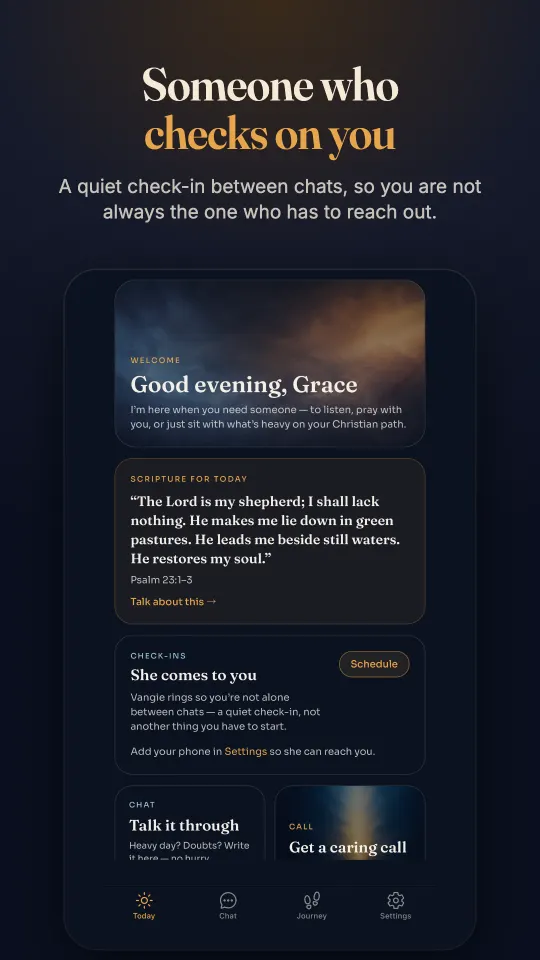
Someone who checks on you
Vangie is an AI faith companion you can talk to any time by chat, or by a gentle phone call that listens first and can end with prayer. Choose Christian as your tradition and she can pray a psalm with you, find a passage that fits what you're carrying, and talk it through; she searches for scripture rather than quoting from memory. She keeps what you're praying for in your Journey, opens each day with a line of scripture on the Today screen, and can call at a time you choose. She isn't a pastor, priest or crisis line, and works best alongside your church and the people around you.
General information, not medical or mental health advice. Vangie is an AI companion: not a licensed counsellor, therapist, doctor or member of the clergy, and not an emergency service. If you are worried about your mental health, talk to your GP or doctor; in the UK, NHS 111 can help if you need urgent help but it isn't an emergency.