
Bible verses and what the Bible says
The Armour of God (Ephesians 6:10-18) explained
The armour of God is Paul's picture in Ephesians 6:10-18 of how Christians stand firm against evil: the belt of truth, the breastplate of righteousness, feet fitted with the gospel of peace, the shield of faith, the helmet of salvation, and the sword of the Spirit, which is the word of God, all worn with prayer.
The armour of God in Ephesians 6
“Finally, be strong in the Lord and in the strength of his might. Put on the whole armour of God, that you may be able to stand against the wiles of the devil. For our wrestling is not against flesh and blood, but against the principalities, against the powers, against the world’s rulers of the darkness of this age, and against the spiritual forces of wickedness in the heavenly places. Therefore put on the whole armour of God, that you may be able to withstand in the evil day, and having done all, to stand.”
Ephesians 6:10-13
Be strong in the Lord and put on the whole armour of God, because the struggle is not against flesh and blood but against spiritual forces of evil; having done everything, stand.
“Stand therefore, having the utility belt of truth buckled around your waist, and having put on the breastplate of righteousness, and having fitted your feet with the preparation of the Good News of peace, above all, taking up the shield of faith, with which you will be able to quench all the fiery darts of the evil one. And take the helmet of salvation, and the sword of the Spirit, which is the word of God; with all prayer and requests, praying at all times in the Spirit, and being watchful to this end in all perseverance and requests for all the saints. Pray for me, that utterance may be given to me in opening my mouth, to make known with boldness the mystery of the Good News, for which I am an ambassador in chains; that in it I may speak boldly, as I ought to speak.”
Ephesians 6:14-20
The pieces of armour, then the call to pray at all times in the Spirit for all God's people, and for Paul himself, an ambassador in chains, to speak boldly.
Bible quotations are from the World English Bible (British Edition), which is in the public domain.
A prayer you can pray
A morning prayer putting on the armour of God
Lord, I want to stand firm today. Fasten your truth around me, and guard my heart with your righteousness. Steady my feet with your peace.
Give me faith to put out every fiery dart of fear and doubt, guard my mind with the hope of your salvation, and bring your word to mind when I need it. Keep me praying, for myself and for the people I love. Amen.
Why Paul uses the picture of armour
Paul was probably writing from prison, quite possibly chained to a Roman soldier, so the image was in front of him. He is clear that the struggle he describes is not against people but against spiritual evil, which is why the pieces of armour are all things God gives rather than weapons for fighting others. Almost every piece is defensive; the only weapon is the word of God. The repeated instruction is to stand: not to charge into battle but to hold your ground when things are hard. For people facing temptation, fear, discouragement or a sense of being under attack, the passage offers a calm, practical picture of what keeps a person steady, and it ends not with a sword stroke but with prayer, for yourself and for others.
The armour of God, piece by piece
- 01
The belt of truth
A soldier's belt held everything else in place. Truth, God's truth and our own honesty, keeps a life from coming apart.
- 02
The breastplate of righteousness
Protects the heart. Christians understand it both as the right standing God gives in Christ and as living rightly, so that guilt and accusation don't find an opening.
- 03
Shoes: the gospel of peace
Footwear gave a soldier grip and readiness to move. The good news of peace with God gives stability and readiness to share that peace.
- 04
The shield of faith
Roman shields were large enough to cover the whole body. Faith, trusting God, puts out the 'flaming arrows' of doubt, fear and temptation.
- 05
The helmet of salvation
Protects the mind with the security of belonging to God, which steadies thinking when anxiety or despair press in.
- 06
The sword of the Spirit
The word of God, the one piece used in response. Jesus answered temptation in the desert by quoting Scripture (Matthew 4:1-11).
- 07
Prayer holds it together
Paul ends with prayer 'at all times', for yourself and for others. Many Christians pray through the pieces of armour each morning.
What tends not to work
Turning the passage against people. Paul says plainly the struggle is not against flesh and blood.
Treating every difficulty as a spiritual attack. Some hard things are illness, stress or circumstance, and need ordinary help as well as prayer.
Leaving out prayer. In Paul's picture, the armour is worn by people who keep praying.
Common questions
What are the 6 pieces of the armour of God?
The belt of truth, the breastplate of righteousness, shoes of the gospel of peace, the shield of faith, the helmet of salvation and the sword of the Spirit (the word of God).
Why does the World English Bible say 'utility belt'?
Translators choose different words for the soldier's belt. Most Bibles say 'belt of truth'; older ones say 'having your loins girt about with truth'. The meaning is the same.
How do you put on the armour of God?
Christians usually describe it as a daily posture rather than a ritual: choosing truth, trusting God, staying rooted in Scripture and praying. Some pray through each piece in the morning.
Where Vangie fits
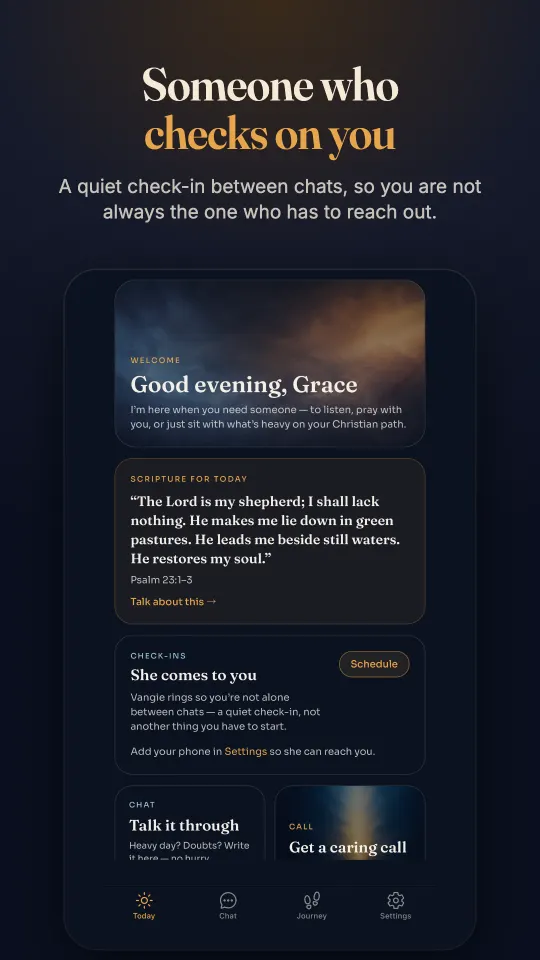
Someone who checks on you
Vangie is an AI faith companion you can chat with any time, or who can ring you for a gentle check-in call at a time you choose. Choose Christian as your tradition and she talks Scripture through with you: she searches for the passage rather than quoting from memory, helps you apply it to what you're actually facing, and prays with you if you'd like. She remembers what you're working on in your Journey and asks how it's going next time, and the Today screen opens with a short Scripture for the day. She isn't a pastor or a crisis line, and works best alongside your church and the people around you.
General information, not medical or mental health advice. Vangie is an AI companion: not a licensed counsellor, therapist, doctor or member of the clergy, and not an emergency service. If you are worried about your mental health, talk to your GP or doctor; in the UK, NHS 111 can help if you need urgent help but it isn't an emergency.