
Bible verses and what the Bible says
Psalm 91 and other psalms for protection
Psalm 91 is the psalm most often prayed for protection, alongside Psalm 121, Psalm 46, Psalm 27 and Psalm 4:8 for safety at night. Christians read them as promises that God shelters and keeps his people in danger, not as a guarantee that nothing bad will ever happen.
Psalm 91 in full, and 5 more psalms for protection
“He who dwells in the secret place of the Most High will rest in the shadow of the Almighty. I will say of the LORD, “He is my refuge and my fortress; my God, in whom I trust.” For he will deliver you from the snare of the fowler, and from the deadly pestilence. He will cover you with his feathers. Under his wings you will take refuge. His faithfulness is your shield and rampart.”
Psalm 91:1-4
The opening image: living in God's shelter, under the shadow of the Almighty. Many people pray these lines when leaving home.
“You shall not be afraid of the terror by night, nor of the arrow that flies by day, nor of the pestilence that walks in darkness, nor of the destruction that wastes at noonday. A thousand may fall at your side, and ten thousand at your right hand; but it will not come near you. You will only look with your eyes, and see the recompense of the wicked.”
Psalm 91:5-8
Dangers by night and by day, named one after another. It speaks to fear of illness and violence as well as war.
“Because you have made the LORD your refuge, and the Most High your dwelling place, no evil shall happen to you, neither shall any plague come near your dwelling. For he will put his angels in charge of you, to guard you in all your ways. They will bear you up in their hands, so that you won’t dash your foot against a stone. You will tread on the lion and cobra. You will trample the young lion and the serpent underfoot.”
Psalm 91:9-13
The section quoted by the devil in the temptation of Jesus, which is a reminder to read it as trust, not as a test of God.
““Because he has set his love on me, therefore I will deliver him. I will set him on high, because he has known my name. He will call on me, and I will answer him. I will be with him in trouble. I will deliver him, and honour him. I will satisfy him with long life, and show him my salvation.””
Psalm 91:14-16
God himself speaks at the end. The promises are relational: I will be with him in trouble, I will answer.
“I will lift up my eyes to the hills. Where does my help come from? My help comes from the LORD, who made heaven and earth. He will not allow your foot to be moved. He who keeps you will not slumber. Behold, he who keeps Israel will neither slumber nor sleep. The LORD is your keeper. The LORD is your shade on your right hand. The sun will not harm you by day, nor the moon by night. The LORD will keep you from all evil. He will keep your soul. The LORD will keep your going out and your coming in, from this time forward, and forever more.”
Psalm 121:1-8
A traveller's psalm, sung by pilgrims on the way to Jerusalem. Often prayed before journeys and over children.
“God is our refuge and strength, a very present help in trouble. Therefore we won’t be afraid, though the earth changes, though the mountains are shaken into the heart of the seas; though its waters roar and are troubled, though the mountains tremble with their swelling. Selah.”
Psalm 46:1-3
God as refuge and strength when everything familiar seems to be shaking. Martin Luther's hymn 'A Mighty Fortress' is based on this psalm.
“The LORD is my light and my salvation. Whom shall I fear? The LORD is the strength of my life. Of whom shall I be afraid? When evildoers came at me to eat up my flesh, even my adversaries and my foes, they stumbled and fell. Though an army should encamp against me, my heart shall not fear. Though war should rise against me, even then I will be confident.”
Psalm 27:1-3
Confidence in God even when surrounded by people who mean harm.
“You are my hiding place. You will preserve me from trouble. You will surround me with songs of deliverance. Selah.”
Psalm 32:7
A short verse picturing God as a hiding place who surrounds you with songs of deliverance.
“In peace I will both lay myself down and sleep, for you alone, the LORD, make me live in safety.”
Psalm 4:8
A bedtime verse: lying down and sleeping in peace because God keeps you safe.
Bible quotations are from the World English Bible (British Edition), which is in the public domain.
Prayers you can pray
A prayer for protection from Psalm 91
Lord, I come to shelter in you. You are my shelter and my strong place, and I choose to trust you today.
Cover me and the people I love. Watch over our going out and our coming in, our homes, our journeys and our nights. Keep us from harm, and when trouble does come, be with us in it as you promised. Give us wisdom to be careful and peace not to be ruled by fear. Amen.
A short prayer over your family at night
God who never sleeps, I place my family in your care tonight. Guard this house and everyone in it. Let us lie down and sleep in peace, and wake to your mercy in the morning. Amen.
How Christians read Psalm 91
Psalm 91 has been prayed for protection for thousands of years: by soldiers, travellers, families during plagues, and parents at children's bedsides. Its pictures are vivid: a fortress, a refuge, the shelter of wings. But it is poetry, and Christians have always read it alongside the rest of scripture, where faithful people still suffer and die. Even the devil quoted Psalm 91 to Jesus, urging him to throw himself from the temple to test it, and Jesus refused (Matthew 4:5–7). So most Christians understand Psalm 91 as a promise that God is our refuge in every danger and that nothing can separate us from his care, rather than a charm that guarantees physical safety. Praying it does not replace sensible precautions; many people pray it while locking the door.
Ways people pray Psalm 91
- 01
Read it aloud, slowly
Psalm 91 was written to be said. Reading it aloud morning or night, perhaps over a sleeping child, is a long-standing practice.
- 02
Make it personal
Many people pray it with names: 'Lord, be a refuge for Sam today'. That keeps it a prayer rather than a formula.
- 03
Pair it with Psalm 121 for journeys
Psalm 121 was sung by travellers. Praying it before a trip, a hospital visit or a new job is common.
- 04
Let it lead to trust, not worry
If praying for protection becomes a ritual you're afraid to miss, step back. The psalm's point is that God's care doesn't depend on getting the words right.
Across Christian traditions
- Catholic and Orthodox
- Bibles and prayer books that follow the Greek Septuagint and Latin Vulgate number most psalms one lower, so Psalm 91 appears as Psalm 90 and Psalm 121 as Psalm 120. Psalm 91 is prayed at Compline (Night Prayer) on Sundays in the Liturgy of the Hours, and is part of Orthodox prayers too.
- Protestant
- Psalm 91 is widely prayed in personal devotion, especially in evangelical and Pentecostal churches, and in times of crisis. Many churches read it at services for the armed forces or during epidemics.
What tends not to work
Treating Psalm 91 as a charm that must be recited perfectly to keep harm away. Christians read it as trust in God's care, not a spell.
Concluding that someone who was harmed didn't have enough faith. Scripture never makes that link, and saying so can deeply hurt people who are grieving.
Skipping practical safety, medical care or reporting danger. Prayer and precaution go together.
Common questions
What is the best psalm for protection?
Psalm 91 is the best known. Psalm 121 is often prayed for journeys and children, Psalm 46 in times of upheaval, Psalm 27 when you feel threatened by people, and Psalm 4 at bedtime.
Does Psalm 91 mean nothing bad will happen to Christians?
Most Christians don't read it that way. The rest of scripture shows faithful people suffering, and Jesus refused to treat Psalm 91 as a guarantee when the devil quoted it. It's read as a promise of God's presence, refuge and final care in every danger.
Why is Psalm 91 called Psalm 90 in some Bibles?
Catholic and Orthodox Bibles often follow the numbering of the Greek and Latin psalters, which combine Psalms 9 and 10. From there until Psalm 147 their numbers are one lower than in most Protestant Bibles.
Can I pray Psalm 91 for someone else?
Yes. Many people pray it over children, partners, soldiers, or friends in hospital, putting the person's name into the lines.
Where Vangie fits
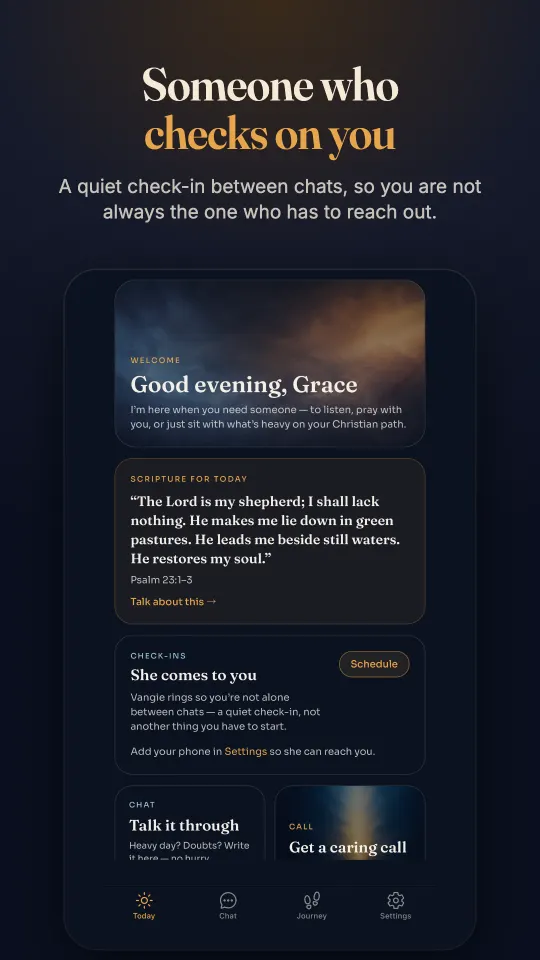
Someone who checks on you
Vangie can pray for protection with you, by chat at any hour or on a gentle phone call that listens first and can end in prayer, in the voice of your own faith. You choose your tradition, and when she shares a psalm she searches scripture from your tradition rather than quoting from memory. She remembers who you're praying for, such as a child travelling or a relative in hospital, so she can ask how they are next time. You can also schedule check-in calls for evenings when worry is worst. She's an AI companion, not a pastor or emergency service; if you're in danger, call 999 or 911.
General information, not medical or mental health advice. Vangie is an AI companion: not a licensed counsellor, therapist, doctor or member of the clergy, and not an emergency service. If you are worried about your mental health, talk to your GP or doctor; in the UK, NHS 111 can help if you need urgent help but it isn't an emergency.