
Bible verses and what the Bible says
Bible verses about fear ("fear not")
Bible verses about fear include Isaiah 41:10, Isaiah 43:1–2, Psalm 23:4, Psalm 27:1, Psalm 56:3–4, John 14:27 and 2 Timothy 1:7. Almost every time the Bible says 'do not be afraid', it gives a reason in the same breath: God is present, and God is with you.
10 Bible verses about fear
“Don’t you be afraid, for I am with you. Don’t be dismayed, for I am your God. I will strengthen you. Yes, I will help you. Yes, I will uphold you with the right hand of my righteousness.”
Isaiah 41:10
The most quoted 'fear not' verse, spoken to exiles. Each reason given is about God's presence and help, not the situation changing.
“But now the LORD who created you, Jacob, and he who formed you, Israel, says: “Don’t be afraid, for I have redeemed you. I have called you by your name. You are mine. When you pass through the waters, I will be with you, and through the rivers, they will not overflow you. When you walk through the fire, you will not be burnt, and flame will not scorch you.”
Isaiah 43:1-2
God calls his people by name, and promises to be with them in the waters and the fire, not to keep every hardship away.
“Even though I walk through the valley of the shadow of death, I will fear no evil, for you are with me. Your rod and your staff, they comfort me.”
Psalm 23:4
The valley is still dark. What changes is who is walking through it with you.
“The LORD is my light and my salvation. Whom shall I fear? The LORD is the strength of my life. Of whom shall I be afraid?”
Psalm 27:1
David asks two questions that turn fear around: if God is light and stronghold, whom should he fear?
“When I am afraid, I will put my trust in you. In God, I praise his word. In God, I put my trust. I will not be afraid. What can flesh do to me?”
Psalm 56:3-4
A realistic prayer: it starts with 'when I am afraid', not 'I am never afraid'.
“I sought the LORD, and he answered me, and delivered me from all my fears.”
Psalm 34:4
A testimony: David sought God and was delivered from all his fears. Many people read it aloud as their own hope.
“Peace I leave with you. My peace I give to you; not as the world gives, I give to you. Don’t let your heart be troubled, neither let it be fearful.”
John 14:27
Jesus offers his peace to frightened friends the night before his arrest, and tells them not to let their hearts be troubled.
“Don’t be afraid, little flock, for it is your Father’s good pleasure to give you the Kingdom.”
Luke 12:32
Spoken to a 'little flock' worried about having enough. Gentle and fatherly in tone.
“For God didn’t give us a spirit of fear, but of power, love, and self-control.”
2 Timothy 1:7
Paul reminds a younger, timid leader that the Spirit God gives is one of power, love and self-control.
“There is no fear in love; but perfect love casts out fear, because fear has punishment. He who fears is not made perfect in love.”
1 John 4:18
About fear of God's judgement in particular: being fully loved by God drives that fear out.
Bible quotations are from the World English Bible (British Edition), which is in the public domain.
A prayer you can pray
A prayer when you're afraid
God, I'm frightened, and my mind keeps running ahead to the worst. You know exactly what I'm afraid of.
In my fear, help me to put my trust in you. Be with me in this, as you promised to be with your people in deep water and in fire. Slow my breathing and my thoughts. Give me the next small step, and the people I need around me. I hand this fear to you for now, and I'll hand it to you again if I pick it back up. Amen.
What 'fear not' means, and what it doesn't
Phrases like 'do not be afraid' appear again and again across the Bible, usually spoken by God or an angel to someone facing something genuinely frightening: a battle, an exile, a visitor from heaven, a storm. They are not a rebuke for having feelings. They are comfort, and they almost always come with a reason: God's own presence. Psalm 56 even admits the fear first and then decides where to put its trust. So reading these verses isn't about pretending you feel brave. It is about bringing your fear to God and remembering who is with you in it. If fear is constant or overwhelming, it may also be anxiety that a doctor can help with, and faith and treatment can go together.
What can help when fear takes hold
- 01
Name the fear to God
Say exactly what you're afraid of, out loud or written down. The Psalms model this kind of honesty.
- 02
Breathe and read slowly
Take a few slow breaths, then read one verse two or three times. Psalm 56:3 is short enough to repeat in the moment.
- 03
Separate the next step from the whole story
Fear often jumps to the end. Ask what you need to do today, or in the next hour, and leave the rest.
- 04
Tell a person
Share the fear with someone you trust or a church leader. If fear or panic is frequent or stopping you living normally, speak to your GP; treatment for anxiety is widely available and works alongside faith.
What tends not to work
Hearing 'fear not' as a telling-off. It is almost always spoken as comfort to people who had good reason to be afraid.
Assuming that feeling fear means your faith has failed. Many faithful people in scripture admit fear openly.
Avoiding medical help for panic or anxiety because you think prayer alone should fix it.
Common questions
How many times does the Bible say 'fear not'?
Phrases like 'fear not' or 'do not be afraid' appear many times, and the exact count depends on the translation and which phrases you include. A popular claim that it appears 365 times, once for every day, isn't supported by most counts, but the theme is undeniably everywhere.
Is fear a sin in the Bible?
Feeling afraid isn't treated as sin. The Bible is full of frightened people whom God comforts. Scripture does warn against letting fear rule decisions or replace trust in God, which is different from simply feeling it.
What does 'the fear of the Lord' mean?
In passages like Proverbs 9:10, the 'fear of the Lord' means deep reverence and awe for God, not terror. It is usually presented as the start of wisdom, and is different from the kind of fear these verses comfort.
Where Vangie fits
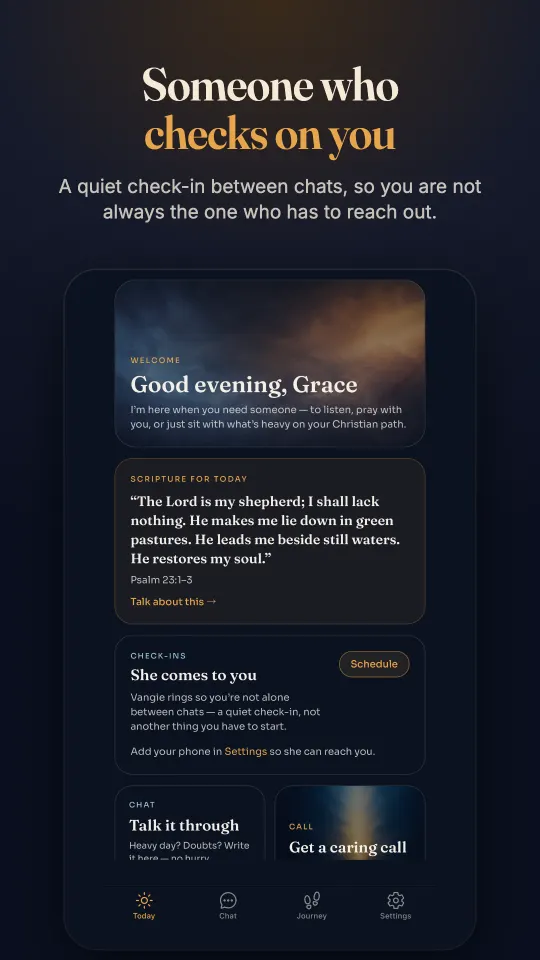
Someone who checks on you
When fear keeps you up or catches you off guard, Vangie is there by chat at any hour, or on a gentle phone call that listens first and can end in prayer. You choose your tradition; when a verse would help, she searches scripture from your own tradition instead of quoting from memory, and talks through what it means for what you're facing. You can schedule check-in calls before something you're dreading, and she remembers what you've been praying about. Vangie is an AI companion, not a counsellor or crisis service.
Sources and support
General information, not medical or mental health advice. Vangie is an AI companion: not a licensed counsellor, therapist, doctor or member of the clergy, and not an emergency service. If you are worried about your mental health, talk to your GP or doctor; in the UK, NHS 111 can help if you need urgent help but it isn't an emergency.