
Bible verses and what the Bible says
Bible verses about anxiety and worry
The Bible verses people turn to most for anxiety are Philippians 4:6–7, which invites you to bring every worry to God in prayer, 1 Peter 5:7, which says to cast your cares on him because he cares for you, and Matthew 6:34, where Jesus says not to borrow tomorrow's worries. Many Christians also lean on Isaiah 41:10, Psalm 94:19 and John 14:27.
12 Bible verses about anxiety, with context
“In nothing be anxious, but in everything, by prayer and petition with thanksgiving, let your requests be made known to God. And the peace of God, which surpasses all understanding, will guard your hearts and your thoughts in Christ Jesus.”
Philippians 4:6-7
Paul wrote this from prison. It doesn't deny the worry; it points it towards prayer and thanksgiving, with the promise that God's peace will keep watch over heart and mind.
“casting all your worries on him, because he cares for you.”
1 Peter 5:7
Written to Christians under pressure. The picture is of throwing a heavy load onto someone strong enough to carry it, because he cares for you.
“Therefore don’t be anxious for tomorrow, for tomorrow will be anxious for itself. Each day’s own evil is sufficient.”
Matthew 6:34
The end of Jesus' teaching on worry in the Sermon on the Mount. Many people find it helps to bring their thoughts back to today alone.
“Therefore I tell you, don’t be anxious for your life: what you will eat, or what you will drink; nor yet for your body, what you will wear. Isn’t life more than food, and the body more than clothing? See the birds of the sky, that they don’t sow, neither do they reap, nor gather into barns. Your heavenly Father feeds them. Aren’t you of much more value than they? “Which of you by being anxious, can add one moment to his lifespan?”
Matthew 6:25-27
Jesus points to the birds and asks what worry adds to a life. A good passage to read slowly, outdoors if you can.
“In the multitude of my thoughts within me, your comforts delight my soul.”
Psalm 94:19
An honest line about a crowd of anxious thoughts, and comfort that meets them rather than shaming them.
“Don’t you be afraid, for I am with you. Don’t be dismayed, for I am your God. I will strengthen you. Yes, I will help you. Yes, I will uphold you with the right hand of my righteousness.”
Isaiah 41:10
Spoken to Israel in exile. Its repeated promises (with you, strengthen, help, uphold) make it one of the most-loved verses for fear and worry.
“Cast your burden on the LORD and he will sustain you. He will never allow the righteous to be moved.”
Psalm 55:22
David wrote Psalm 55 when betrayed by a close friend. This verse invites you to hand the burden over and trust you'll be held.
“Peace I leave with you. My peace I give to you; not as the world gives, I give to you. Don’t let your heart be troubled, neither let it be fearful.”
John 14:27
Jesus' words to his friends on the night before he died, when they were afraid. A favourite verse to say before sleep.
““Come to me, all you who labour and are heavily burdened, and I will give you rest. Take my yoke upon you and learn from me, for I am gentle and humble in heart; and you will find rest for your souls. For my yoke is easy, and my burden is light.””
Matthew 11:28-30
An invitation to the weary and burdened. Many people pray it when anxiety has become plain exhaustion.
“I sought the LORD, and he answered me, and delivered me from all my fears.”
Psalm 34:4
A testimony: the writer sought God and was delivered from his fears. Good for remembering times you have come through before.
“Anxiety in a man’s heart weighs it down, but a kind word makes it glad.”
Proverbs 12:25
Practical wisdom that anxiety weighs a person down and a kind word lifts them. A reminder to tell someone, not carry it alone.
“For God didn’t give us a spirit of fear, but of power, love, and self-control.”
2 Timothy 1:7
Paul to his younger friend Timothy, who seems to have been timid. It speaks of a spirit of power, love and self-control rather than fear.
Bible quotations are from the World English Bible (British Edition), which is in the public domain.
A prayer you can pray
A prayer when worry won't stop
Lord, my thoughts are running ahead of me and I can't slow them down. You've asked me to bring you everything, so here it is: the things I'm afraid of, the things I can't fix, the things I keep going over.
I cast these cares on you, because you care for me. Give me enough for today and help me leave tomorrow with you. Let your peace, which I can't explain, guard my heart and my mind tonight. Amen.
Why do verses sometimes feel hollow when you're anxious?
Anxiety lives in the body as much as in the mind: a racing heart, a tight chest, thoughts that loop at 3am. A verse read once, quickly, can't always reach that, and some people end up feeling worse, as if still being anxious means their faith is weak. The Bible itself doesn't treat worry that way. The Psalms are full of people who are troubled and say so plainly, and Jesus was in anguish in Gethsemane. Verses tend to help most when they're read slowly, in their setting, and prayed back rather than used as a test you're failing. And faith and medical help go together: talking therapies and your GP or doctor are good gifts too, not a sign of giving up on God.
How to use these verses
- 01
Choose one, not twelve
Pick the verse that catches you and stay with it for a week. One line you know by heart is easier to reach for at 3am than a list.
- 02
Read the whole passage
Look up the chapter around it. Philippians 4 and Matthew 6 both make more sense, and comfort more, in context.
- 03
Pray it back
Turn the verse into your own words to God: what you're anxious about, and what the verse says he will do.
- 04
Put it where you'll see it
Write it on a card by the bed or set it as your phone's lock screen, so it's there when the worry starts.
- 05
Tell someone
Share the verse with a friend, your church or a prayer partner, and tell them what you're worried about. Being known helps.
What tends not to work
Using a verse to shame yourself for still feeling anxious. The Psalms show that faithful people feel afraid too.
Pulling one line out of its setting and treating it as a guarantee about a specific outcome.
Reading verses instead of getting help. If anxiety is affecting sleep, work or eating, talk to your GP or doctor as well as to God.
Common questions
What is the most comforting Bible verse for anxiety?
Philippians 4:6–7 is the one most often quoted, because it pairs prayer with a promise of peace. Many people also find 1 Peter 5:7, Isaiah 41:10 or Matthew 11:28 more comforting on a particular day. The best verse is the one that speaks to you.
Is anxiety a sin?
Christians answer this gently and in different ways. Jesus' words in Matthew 6 invite people not to worry, but the Bible also shows faithful people, including Jesus in Gethsemane, in deep distress. Most pastors distinguish between feeling anxious, which is human, and being invited to bring that anxiety to God rather than carry it alone. Anxiety that won't lift is also a health matter worth taking to a doctor.
Can I take medication or have therapy for anxiety as a Christian?
Yes. Most churches see medical care and therapy as good gifts that work alongside prayer. In the UK you can refer yourself to NHS Talking Therapies for anxiety, or speak to your GP.
Which psalm is good for anxiety?
Psalm 23, Psalm 46, Psalm 55, Psalm 94 and Psalm 139 are often read by people who are anxious. Our guide to psalms for anxiety goes through them.
Where Vangie fits
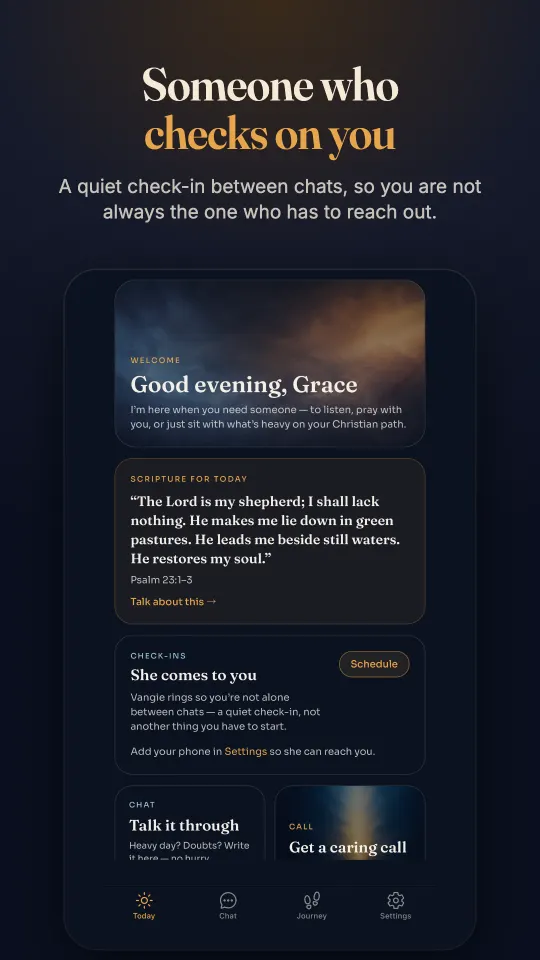
Someone who checks on you
Vangie is an AI companion you can talk to about what's weighing on you, by chat any time or on a gentle phone call that listens first and can end in prayer. You choose your tradition, and when you're Christian she searches the Bible for a passage that fits what you're facing, quotes it accurately rather than from memory, and talks it through with you. She can pray with you, remembers what you're praying for in your Journey so she can ask how it's going, and opens each day with a Scripture for today. You can also schedule a check-in call at a time you choose. She is not a pastor or a crisis line, and she'll encourage you to lean on your church and the people around you too.
Sources and support
General information, not medical or mental health advice. Vangie is an AI companion: not a licensed counsellor, therapist, doctor or member of the clergy, and not an emergency service. If you are worried about your mental health, talk to your GP or doctor; in the UK, NHS 111 can help if you need urgent help but it isn't an emergency.