
Bible verses and what the Bible says
Psalms for anxiety and sleepless nights
Psalms that help with anxiety and sleepless nights include Psalm 4:8, Psalm 3:5, Psalm 23, Psalm 42:11, Psalm 55:22, Psalm 62, Psalm 94:19, Psalm 121 and Psalm 131. They give honest words for a troubled mind and end by resting in God's care.
10 psalms for anxiety and sleepless nights
“In peace I will both lay myself down and sleep, for you alone, the LORD, make me live in safety.”
Psalm 4:8
Perhaps the best-known bedtime verse. Many people say it as the last thing before turning out the light.
“I laid myself down and slept. I awakened, for the LORD sustains me.”
Psalm 3:5
Written while David was fleeing danger, yet he lay down, slept and woke again because God sustained him.
“The LORD is my shepherd; I shall lack nothing. He makes me lie down in green pastures. He leads me beside still waters. He restores my soul. He guides me in the paths of righteousness for his name’s sake. Even though I walk through the valley of the shadow of death, I will fear no evil, for you are with me. Your rod and your staff, they comfort me.”
Psalm 23:1-4
Still waters and green pastures, then the dark valley. A psalm for nights when you need to feel led.
“Why are you in despair, my soul? Why are you disturbed within me? Hope in God! For I shall still praise him, the saving help of my countenance, and my God.”
Psalm 42:11
The psalmist talks to his own anxious soul and tells it to hope in God. A model for answering your own racing thoughts.
“Cast your burden on the LORD and he will sustain you. He will never allow the righteous to be moved.”
Psalm 55:22
Cast your burden on the Lord. Some people picture physically putting a weight down as they pray it.
“My soul rests in God alone. My salvation is from him. He alone is my rock, my salvation, and my fortress. I will never be greatly shaken.”
Psalm 62:1-2
Waiting in silence for God. Good for when you're tired of words and just need stillness.
“In the multitude of my thoughts within me, your comforts delight my soul.”
Psalm 94:19
Directly about a mind full of anxious thoughts, and God's comfort meeting them.
“He will not allow your foot to be moved. He who keeps you will not slumber. Behold, he who keeps Israel will neither slumber nor sleep.”
Psalm 121:3-4
The one who keeps you neither slumbers nor sleeps, so you can.
“It is vain for you to rise up early, to stay up late, eating the bread of toil, for he gives sleep to his loved ones.”
Psalm 127:2
A gentle challenge to sleepless worrying: God gives sleep to those he loves.
“LORD, my heart isn’t arrogant, nor my eyes lofty; nor do I concern myself with great matters, or things too wonderful for me. Surely I have stilled and quieted my soul, like a weaned child with his mother, like a weaned child is my soul within me. Israel, hope in the LORD, from this time forward and forever more.”
Psalm 131:1-3
Three short verses picturing a calmed soul like a weaned child with its mother. Ideal for praying lying down.
Bible quotations are from the World English Bible (British Edition), which is in the public domain.
A prayer you can pray
A prayer for a night you can't sleep
Lord, it's late and my mind won't stop. I keep turning the same things over and I can't fix any of them tonight.
I hand them to you, one by one. You are awake, so I don't need to be. Quiet my thoughts, slow my breathing, and let me rest in you like a child resting with its mother. Whatever tomorrow holds, you will be there first. Give me sleep, and if sleep won't come, give me peace while I lie here. Amen.
Why the Psalms help when your mind won't settle
Anxious thoughts are often loudest at night, when there is nothing to distract you and problems look bigger than they are. The Psalms are unusually good company then, because many were written by people who couldn't sleep either: David fleeing his own son in Psalm 3, a downcast singer arguing with his own soul in Psalm 42. They don't pretend everything is fine. They name the worry, then turn deliberately towards God's care. Saying a short psalm slowly also slows your breathing and gives your mind something steady to hold, which is part of why people across centuries have prayed them before sleep. If anxiety or poor sleep goes on for weeks, the NHS suggests talking to a GP; psalms and proper help can work together.
How to pray the psalms when you're anxious
- 01
Keep one psalm by the bed
Choose a short one, such as Psalm 4:8 or Psalm 131, and leave it on a card or saved on your phone so you don't have to search at 3am.
- 02
Read it slowly, in time with your breathing
Breathe in on one phrase and out on the next. Repeating a few lines is fine; it isn't a test of how much you read.
- 03
Write the worry down first
Jotting down what's on your mind, and one thing you'll do about it tomorrow, can stop it circling. Then pray the psalm.
- 04
Get help if it keeps happening
If worry or sleeplessness lasts for weeks or affects your days, talk to your GP. NHS Talking Therapies (in England you can refer yourself) help many people of faith with anxiety.
What tends not to work
Scrolling for the 'right' verse in bed. The phone screen and searching tend to wake you up more.
Treating continued anxiety as a sign your faith isn't strong enough. The psalm writers were anxious too.
Forcing yourself to lie awake 'until you've prayed it right'. If you can't sleep after a while, get up, do something calm, and try again later.
Common questions
What psalm should I read before bed?
Psalm 4 (especially verse 8), Psalm 91, Psalm 121, Psalm 131 and Psalm 134 are all traditional night psalms. Psalms 4, 91 and 134 are prayed at Compline, the Church's night prayer.
Which psalm is for anxiety?
Psalm 94:19 speaks directly about anxious thoughts. Psalm 42 and 43, Psalm 55, Psalm 62 and Psalm 131 are also widely prayed by anxious people.
Is it OK to take medication for anxiety as a Christian?
Yes. Most Christian traditions see medical treatment as a good gift, and many church leaders encourage people to seek help. Decisions about medication are for you and your doctor.
Where Vangie fits
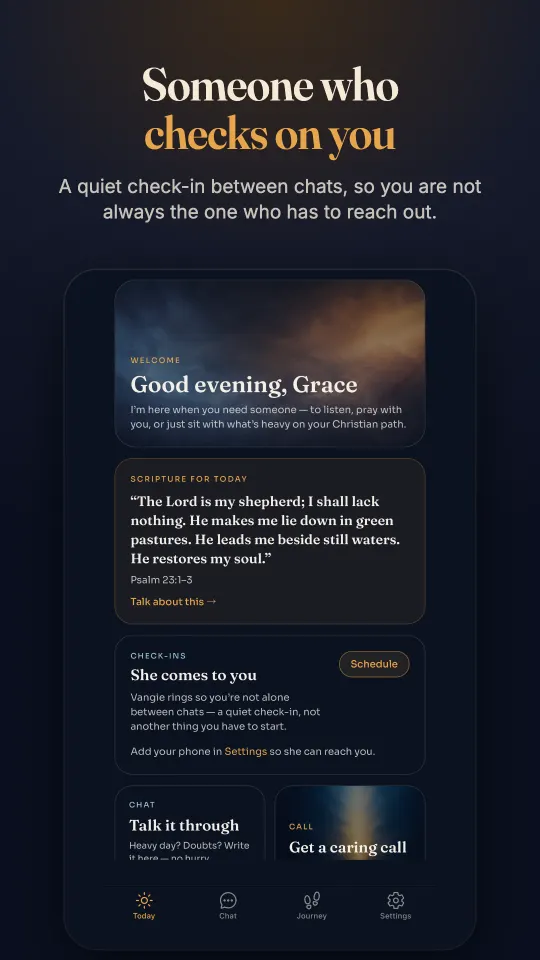
Someone who checks on you
Vangie is there at night, by chat whenever you're awake, or by a gentle phone call that listens first and can end with a prayer for rest. You choose your tradition, and when a psalm would help she searches scripture from your own tradition rather than quoting from memory, then helps you pray it. You can schedule a check-in call for the evening, and she remembers what you've been worried about so she can ask how it went. Vangie is an AI companion, not a doctor or crisis line.
Sources and support
General information, not medical or mental health advice. Vangie is an AI companion: not a licensed counsellor, therapist, doctor or member of the clergy, and not an emergency service. If you are worried about your mental health, talk to your GP or doctor; in the UK, NHS 111 can help if you need urgent help but it isn't an emergency.