
Bible verses and what the Bible says
Psalm 121 meaning, verse by verse
Psalm 121 is a short song of trust for travellers: the writer looks up at the hills, asks where help will come from, and answers that it comes from the LORD, the maker of heaven and earth, who never sleeps and keeps you on every road, by day and by night, now and for ever.
Psalm 121, the whole psalm
“I will lift up my eyes to the hills. Where does my help come from? My help comes from the LORD, who made heaven and earth.”
Psalm 121:1-2
The question and the answer. Looking up at the hills, the traveller asks where help will come from, and answers: from the LORD who made heaven and earth.
“He will not allow your foot to be moved. He who keeps you will not slumber. Behold, he who keeps Israel will neither slumber nor sleep.”
Psalm 121:3-4
The keeper who never dozes. Unlike the traveller, who must sleep, the God who keeps Israel never slumbers.
“The LORD is your keeper. The LORD is your shade on your right hand. The sun will not harm you by day, nor the moon by night.”
Psalm 121:5-6
The LORD as shade at your right hand, so that neither the sun by day nor the moon by night will harm you.
“The LORD will keep you from all evil. He will keep your soul. The LORD will keep your going out and your coming in, from this time forward, and forever more.”
Psalm 121:7-8
The closing blessing: kept from all evil, your life kept, your going out and coming in kept, now and for ever.
Bible quotations are from the World English Bible (British Edition), which is in the public domain.
Prayers you can pray
A prayer before a journey, from Psalm 121
LORD, maker of heaven and earth, I lift my eyes to you. You know the road ahead of me today.
Keep my feet steady. Stay awake when I am tired. Be my shade in the heat and my peace in the night.
Watch over my going out and my coming home, and over everyone I love while we are apart. Amen.
A short prayer for someone travelling
Keeper of Israel, who never sleeps, watch over them on the road today. Bring them safely there and safely home. Amen.
Why do people turn to Psalm 121?
Psalm 121 is one of the fifteen 'Songs of Ascents' (Psalms 120 to 134), which many scholars believe pilgrims sang as they walked up to Jerusalem for the festivals. The road was long, hot and exposed, and the hills could hide robbers as easily as they could shelter a traveller. Into that setting the psalm speaks a simple promise, repeated six times in eight verses: God keeps you. The Hebrew word for 'keep' runs through the whole psalm like a refrain. That is why it has become the psalm people read before a journey, a move, an operation, a first day somewhere new, or any time they feel exposed. It doesn't promise that nothing hard will happen. It promises a keeper who is awake when you are not, and who stays with you on the way out and the way home.
Psalm 121, verse by verse
- 01
Verse 1: I lift up my eyes
The hills are where the traveller is heading and where danger might hide. The question is honest: where will help come from when I'm exposed?
- 02
Verse 2: from the maker of heaven and earth
The answer points beyond the hills to the one who made them. Help comes from someone bigger than the threat.
- 03
Verses 3 and 4: he will not slumber
Feet that slip and a God who never sleeps. Notice the voice changes here; someone else seems to answer the traveller, as if the psalm were sung back and forth.
- 04
Verses 5 and 6: shade by day and night
In a hot, dry land, shade at your right hand meant protection close by. Sun by day and moon by night together mean every hour.
- 05
Verses 7 and 8: going out and coming in
The blessing widens to your whole life: kept from evil, your soul kept, every departure and return kept, for ever.
Across traditions
- Jewish
- Psalm 121 is part of the Hebrew Bible's Songs of Ascents and has long been recited in times of danger and illness, and by travellers. Its text is often printed on cards and amulets placed near a newborn or carried on journeys.
- Psalm numbering
- Orthodox Bibles, and older Catholic ones such as the Douay-Rheims, follow the ancient Greek and Latin numbering and list it as Psalm 120; most modern Catholic Bibles use the Hebrew numbering. It appears in the Church's daily prayer and is a common reading for pilgrimages.
- Protestant
- It is a favourite at farewells, commissionings and funerals, and has been set as a hymn and as many songs.
What tends not to work
Reading verse 7 as a promise that nothing bad will ever happen. The psalm promises God's keeping, not an easy road.
Treating it as a charm to say before travel instead of a prayer of trust.
Skipping the honest question in verse 1. It is fine to admit you feel exposed.
Common questions
Who wrote Psalm 121?
The psalm has no author named in its heading, only 'A Song of Ascents'. It belongs to the group of pilgrim songs in Psalms 120 to 134.
What does 'I will lift up my eyes to the hills' mean?
The traveller looks at the hills ahead, on the way up to Jerusalem, and asks where help will come from. The answer is not the hills themselves but the LORD who made them.
Is Psalm 121 a prayer for protection?
Yes. It is one of the best-known psalms of protection, alongside Psalm 91, and is often prayed before travel or for someone far from home.
What does 'the sun will not harm you by day, nor the moon by night' mean?
The sun and moon together stand for every hour of day and night. In a hot climate the sun was a real danger to travellers; the line pictures God's protection around the clock.
Where Vangie fits
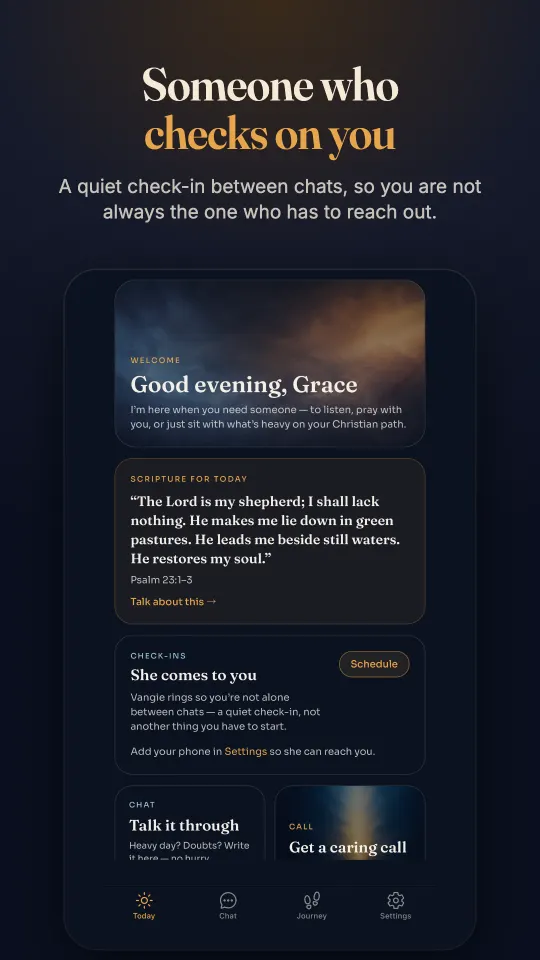
Someone who checks on you
Vangie is an AI faith companion you can talk to any time by chat, or by a gentle phone call that listens first and can end with prayer. Choose Christian as your tradition and she can pray a psalm with you, find a passage that fits what you're carrying, and talk it through; she searches for scripture rather than quoting from memory. She keeps what you're praying for in your Journey, opens each day with a line of scripture on the Today screen, and can call at a time you choose. She isn't a pastor, priest or crisis line, and works best alongside your church and the people around you.
General information, not medical or mental health advice. Vangie is an AI companion: not a licensed counsellor, therapist, doctor or member of the clergy, and not an emergency service. If you are worried about your mental health, talk to your GP or doctor; in the UK, NHS 111 can help if you need urgent help but it isn't an emergency.