
Bible verses and what the Bible says
The Ten Commandments, listed and explained
The Ten Commandments are the laws God gives Israel at Mount Sinai in Exodus 20:1-17 (and again in Deuteronomy 5:6-21). In the numbering most Protestants use they are: no other gods; no idols; don't misuse God's name; keep the Sabbath; honour your parents; don't murder; don't commit adultery; don't steal; don't give false testimony; don't covet. Jewish and Catholic traditions divide the same text differently.
The Ten Commandments in Exodus 20
“God spoke all these words, saying, “I am the LORD your God, who brought you out of the land of Egypt, out of the house of bondage. “You shall have no other gods before me. “You shall not make for yourselves an idol, nor any image of anything that is in the heavens above, or that is in the earth beneath, or that is in the water under the earth: you shall not bow yourself down to them, nor serve them, for I, the LORD your God, am a jealous God, visiting the iniquity of the fathers on the children, on the third and on the fourth generation of those who hate me, and showing loving kindness to thousands of those who love me and keep my commandments.”
Exodus 20:1-6
God introduces himself as the one who brought Israel out of slavery, then forbids other gods and the making and worship of idols.
“You shall not misuse the name of the LORD your God, for the LORD will not hold him guiltless who misuses his name. “Remember the Sabbath day, to keep it holy. You shall labour six days, and do all your work, but the seventh day is a Sabbath to the LORD your God. You shall not do any work in it, you, nor your son, nor your daughter, your male servant, nor your female servant, nor your livestock, nor your stranger who is within your gates; for in six days the LORD made heaven and earth, the sea, and all that is in them, and rested the seventh day; therefore the LORD blessed the Sabbath day, and made it holy.”
Exodus 20:7-11
Do not misuse God's name; remember the Sabbath day and keep it holy, a day of rest for everyone in the household, rooted in God's rest after creation.
“Honour your father and your mother, that your days may be long in the land which the LORD your God gives you. “You shall not murder. “You shall not commit adultery. “You shall not steal. “You shall not give false testimony against your neighbour. “You shall not covet your neighbour’s house. You shall not covet your neighbour’s wife, nor his male servant, nor his female servant, nor his ox, nor his donkey, nor anything that is your neighbour’s.””
Exodus 20:12-17
Honour your father and mother; do not murder, commit adultery, steal or give false testimony; do not covet your neighbour's house, spouse or anything that belongs to them.
Bible quotations are from the World English Bible (British Edition), which is in the public domain.
A prayer you can pray
A prayer before the commandments
Lord, you brought your people out of slavery before you gave them your law. Thank you for setting me free, too.
Help me love you above everything, honour your name, and rest in you. Help me treat the people around me with faithfulness, honesty and respect, and free me from wanting what isn't mine. Amen.
Why the Ten Commandments still matter, and why they're numbered differently
The Ten Commandments are among the most influential words ever written, but people often meet them as a list of prohibitions cut off from their story. In Exodus they come after God has rescued Israel from slavery in Egypt. The first line is not a rule but a reminder: I am the LORD your God, who brought you out. The commandments describe how a freed people should live with God and with one another. The Bible calls them 'the ten words' but never numbers them, which is why traditions divide the same verses differently. Jews count the opening statement as the first word; Catholics and Lutherans join the first two prohibitions and split the last; most other Protestants and the Orthodox separate the ban on idols. The content is the same.
The Ten Commandments explained (common Protestant numbering)
- 01
1. No other gods
God alone is to be worshipped. Christians often apply this to anything that takes God's place: money, success, approval.
- 02
2. No idols
Don't make or bow down to images as gods. In Catholic and Lutheran numbering this is part of the first commandment.
- 03
3. Don't misuse God's name
Not only swearing, but using God's name to back up lies, empty promises or manipulation.
- 04
4. Keep the Sabbath holy
A weekly day of rest and worship. Jews keep Shabbat from Friday evening to Saturday evening; most Christians keep Sunday as the Lord's Day.
- 05
5. Honour your father and mother
The first commandment with a promise attached. It concerns respect and care across a whole life, not only obedience in childhood.
- 06
6. Do not murder
Protects human life. Jesus later extends it to the anger and contempt that lead to violence (Matthew 5:21-22).
- 07
7. Do not commit adultery
Protects faithfulness in marriage.
- 08
8. Do not steal
Protects property and fairness, including in work and trade.
- 09
9. Do not give false testimony
Originally about lying in court; applied more widely to slander and dishonesty.
- 10
10. Do not covet
Turns from actions to desires: wanting what belongs to someone else. Catholic and Lutheran numbering divides this into two commandments.
How traditions number them
- Jewish
- The first 'word' is 'I am the LORD your God, who brought you out of Egypt'. The second combines no other gods and no idols. The remaining eight follow, with coveting as one.
- Catholic and Lutheran
- Following St Augustine, no other gods and no idols form the first commandment. Coveting is split in two. Catholics: your neighbour's wife (ninth) and your neighbour's goods (tenth); Lutherans, following the order in Exodus: your neighbour's house (ninth), and his wife, servants, animals and everything else (tenth).
- Orthodox and most Protestants
- No other gods (first) and no idols (second) are separate, and coveting is one commandment (tenth), as in the list above.
What tends not to work
Starting at 'You shall have no other gods' and skipping the rescue that comes first. The commandments begin with God's grace.
Arguing about which numbering is 'right'. The text is the same; traditions divide it differently.
Treating the list as only about outward actions. The last commandment, against coveting, is about the heart.
Common questions
Where are the Ten Commandments in the Bible?
Exodus 20:1-17 and Deuteronomy 5:6-21. Exodus describes them being given at Mount Sinai; Deuteronomy has Moses repeating them before Israel enters the promised land.
Why do Catholic and Protestant lists differ?
The Bible says there are ten but doesn't number them. Catholics and Lutherans follow Augustine's division; most other Protestants and the Orthodox follow an older division also found in early Jewish writers. The words are the same.
Do Christians still follow the Ten Commandments?
Most Christians hold that the moral commands still apply, summarised by Jesus as loving God and loving your neighbour. Practice around the Sabbath varies: most Christians keep Sunday, some keep Saturday.
Where Vangie fits
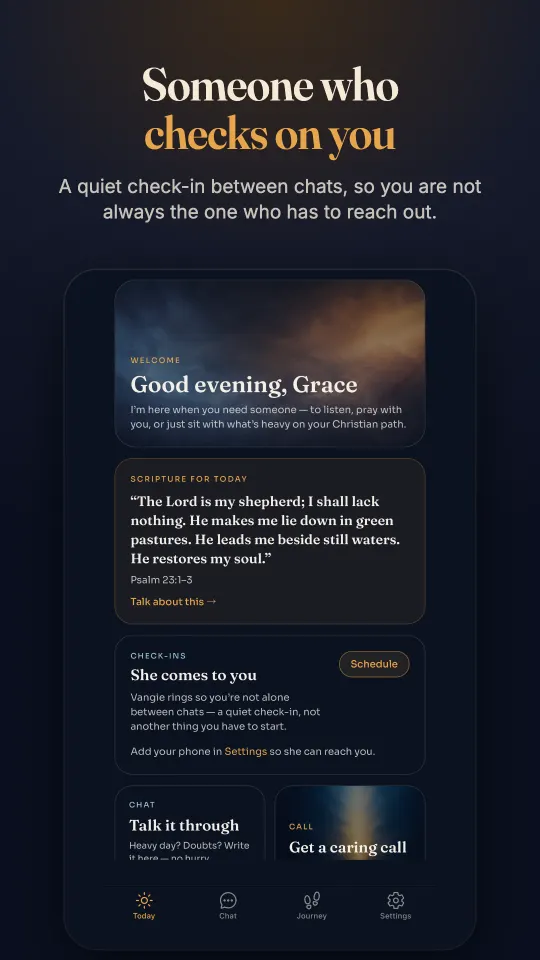
Someone who checks on you
Vangie is an AI faith companion you can chat with any time, or who can ring you for a gentle check-in call at a time you choose. Choose Christian as your tradition and she talks Scripture through with you: she searches for the passage rather than quoting from memory, helps you apply it to what you're actually facing, and prays with you if you'd like. She remembers what you're working on in your Journey and asks how it's going next time, and the Today screen opens with a short Scripture for the day. She isn't a pastor or a crisis line, and works best alongside your church and the people around you.
General information, not medical or mental health advice. Vangie is an AI companion: not a licensed counsellor, therapist, doctor or member of the clergy, and not an emergency service. If you are worried about your mental health, talk to your GP or doctor; in the UK, NHS 111 can help if you need urgent help but it isn't an emergency.