
How to pray and read the Bible
How to read the Bible for beginners: where to start
Beginners usually do best starting with a Gospel, such as Mark (short and fast) or Luke (detailed and warm), then Acts, the Psalms, and Genesis, reading a short section each day rather than going from cover to cover. Use a readable translation, ask what the passage says and what it means for you, and read with others if you can.
Bible verses
“but these are written that you may believe that Jesus is the Christ, the Son of God, and that believing you may have life in his name.”
John 20:31
John explains why his Gospel was written: so that readers may believe and have life. A good reason to start with a Gospel.
“Every Scripture is God-breathed and profitable for teaching, for reproof, for correction, and for instruction in righteousness, that each person who belongs to God may be complete, thoroughly equipped for every good work.”
2 Timothy 3:16-17
How the early church saw scripture: inspired, and useful for teaching and training in everyday life.
“Your word is a lamp to my feet, and a light for my path.”
Psalm 119:105
Scripture as a lamp for your feet: light for the next step rather than the whole map at once.
“Philip ran to him, and heard him reading Isaiah the prophet, and said, “Do you understand what you are reading?” He said, “How can I, unless someone explains it to me?” He begged Philip to come up and sit with him.”
Acts 8:30-31
An official reading Isaiah asks how he can understand without someone to guide him. Reading with others is as old as the church.
“Now these were more noble than those in Thessalonica, in that they received the word with all readiness of mind, examining the Scriptures daily to see whether these things were so.”
Acts 17:11
The Bereans examined the scriptures daily, with eagerness and care, a model for reading thoughtfully.
“Beginning from Moses and from all the prophets, he explained to them in all the Scriptures the things concerning himself.”
Luke 24:27
Jesus explaining the scriptures to two disciples on the road to Emmaus, showing how the Old Testament points to him.
Bible quotations are from the World English Bible (British Edition), which is in the public domain.
A prayer you can pray
A prayer before reading the Bible
God, thank you for your word. As I read, help me to understand it, to see Jesus in it, and to hear what you want to say to me. Where I'm confused, give me patience and good guides. Where I'm challenged, give me courage to change. Amen.
Why is the Bible hard to read on your own?
The Bible isn't one book but a library of 66 books in most Protestant Bibles (more in Catholic and Orthodox ones), written over many centuries in different styles: history, law, poetry, prophecy, letters and Gospels. Many beginners open at Genesis, enjoy the stories, then stall in the detailed laws of Leviticus or the lists of Numbers and give up feeling the Bible isn't for them. Others pick a translation whose old language feels like a barrier. Knowing where to start, choosing a readable version and having a simple way to reflect makes a huge difference. The aim isn't to finish quickly but to understand and be changed by what you read.
Where to start, step by step
- 01
Start with a Gospel
Mark is the shortest Gospel and moves quickly; Luke is fuller and tells many of the best-known parables; John is more reflective. Reading one Gospel first introduces you to Jesus, who is at the centre of the Christian faith.
- 02
Then read Acts, Psalms and Genesis
Acts tells what happened after Jesus' resurrection, as the church spread. The Psalms give words for every emotion and are good for prayer. Genesis tells the beginning of the story. After that, a short letter such as Philippians or James is a good next step.
- 03
Choose a readable translation
Bibles come in many English translations. Some aim for word-for-word accuracy (for example the ESV or NRSV), some for natural modern English (such as the NIV), and some keep older language (the King James Version). The World English Bible is a modern translation in the public domain. Use one you can understand; you can compare others later.
- 04
Read a little every day
A chapter, or even a paragraph, read daily is better than a long session once a week. Many free reading plans take you through a Gospel in a month or the New Testament in a year.
- 05
Ask three questions
What does this passage say? What did it mean to the people who first heard it? What might it mean for me today? Writing a line in a notebook helps it stay with you.
- 06
Use the notes and introductions
A study Bible or simple commentary explains background, unfamiliar customs and hard passages. Don't worry about understanding everything at once; even long-time readers keep discovering things.
- 07
Read with other people
A church Bible study, a friend, or a small group helps with questions you can't answer alone and keeps you going.
Across Christian traditions
- Catholic
- Catholic Bibles include the deuterocanonical books, such as Tobit, Judith, Wisdom, Sirach and 1 and 2 Maccabees, giving 73 books. The daily Mass readings are a structured way to read through much of the Bible over a three-year cycle.
- Orthodox
- Orthodox Bibles include the deuterocanonical books and some further texts. Scripture is read within the church's worship and the teaching of the Church Fathers, and the Psalms are central to daily prayer.
- Protestant
- Most Protestant Bibles have 66 books: 39 in the Old Testament and 27 in the New. Personal daily reading is strongly encouraged, often with a reading plan.
- Anglican
- Anglican Bibles may include the Apocrypha (the deuterocanonical books) in a separate section. The lectionary used in Morning and Evening Prayer takes readers through much of the Bible across the year.
What tends not to work
Reading straight through from Genesis as your first attempt. It's possible, but many people stall in Leviticus.
Reading single verses out of context. Read the whole paragraph or chapter around a verse to see what it means.
Feeling you must understand everything before moving on. Note your questions and keep reading.
Common questions
Which book of the Bible should I read first?
Most people recommend a Gospel first: Mark if you want something short, Luke if you want the fullest account, or John if you prefer something more reflective.
Which Bible translation is best for beginners?
One you can read easily. Modern translations such as the NIV are widely used; the ESV and NRSV are popular for study; the King James Version is loved for its language but is harder for many beginners. Catholic readers will want a Catholic edition that includes the deuterocanonical books.
How long does it take to read the whole Bible?
Reading plans usually take a year at about 15 minutes a day. There's no need to rush; reading slowly with understanding matters more.
Why do Catholic and Protestant Bibles have different numbers of books?
Catholic and Orthodox Bibles include several Old Testament books, called deuterocanonical, that most Protestant Bibles leave out or place in a separate Apocrypha section. The New Testament is the same in all of them.
Where Vangie fits
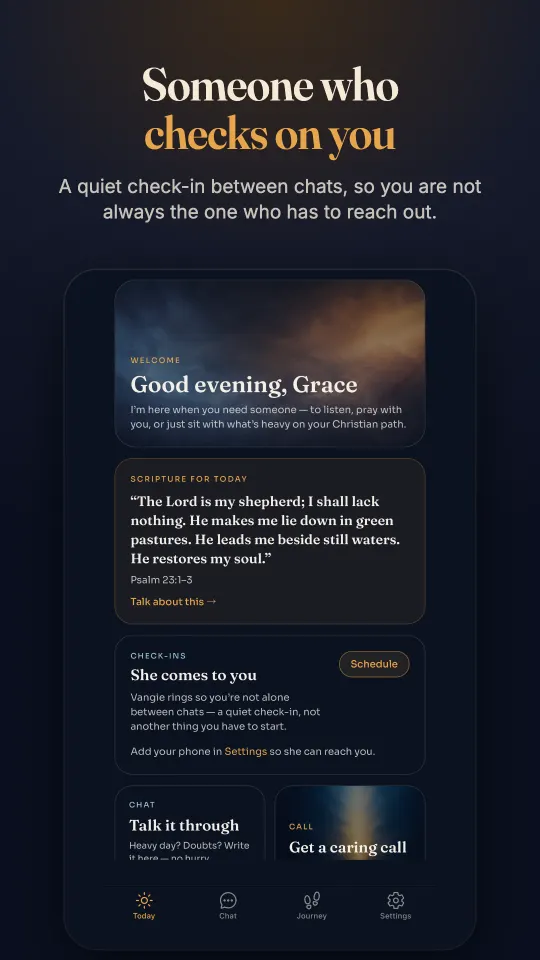
Someone who checks on you
Vangie can be a patient companion while you start reading. Choose Christian as your tradition, and you can ask her what a passage means, why it matters, or where to read next; she searches the scripture itself rather than quoting from memory, and talks it through in plain language. The Today screen also offers a Scripture for today to start with. You can set a check-in call for your reading time, and she remembers what you've been reflecting on so she can follow up. She's an AI companion, not a Bible scholar or pastor, so for deeper questions she'll encourage you towards a church or study group.
General information, not medical or mental health advice. Vangie is an AI companion: not a licensed counsellor, therapist, doctor or member of the clergy, and not an emergency service. If you are worried about your mental health, talk to your GP or doctor; in the UK, NHS 111 can help if you need urgent help but it isn't an emergency.