
How to pray and read the Bible
How to do a daily devotional (a 15-minute plan)
A daily devotional is a short, regular time with God: read a small passage of the Bible, think about what it says and what it means for you today, then pray in response. A simple 15-minute plan is two minutes to settle, five to read, four to reflect or journal, and four to pray.
Bible verses
“LORD, in the morning you will hear my voice. In the morning I will lay my requests before you, and will watch expectantly.”
Psalm 5:3
Morning prayer in the Psalms: bringing requests to God at the start of the day and watching expectantly.
“Early in the morning, while it was still dark, he rose up and went out, and departed into a deserted place, and prayed there.”
Mark 1:35
Jesus himself rising early and going to a quiet place to pray, the model many people follow for a morning devotional.
“Your word is a lamp to my feet, and a light for my path.”
Psalm 119:105
Scripture as a lamp for the next step, which is exactly what a short daily reading is for.
“It is because of The LORD’s loving kindnesses that we are not consumed, because his mercies don’t fail. They are new every morning. Great is your faithfulness.”
Lamentations 3:22-23
Mercies that are new every morning, a good reminder on a day you're starting again after a gap.
“Blessed is the man who doesn’t walk in the counsel of the wicked, nor stand on the path of sinners, nor sit in the seat of scoffers; but his delight is in the LORD’s law. On his law he meditates day and night. He will be like a tree planted by the streams of water, that produces its fruit in its season, whose leaf also does not wither. Whatever he does shall prosper.”
Psalm 1:1-3
The picture of someone who meditates on God's word day and night, like a tree planted by water.
“But be doers of the word, and not only hearers, deluding your own selves.”
James 1:22
Reading is meant to lead to doing. A devotional ends well with one small thing to put into practice.
Bible quotations are from the World English Bible (British Edition), which is in the public domain.
Prayers you can pray
A prayer before you read
Lord, as I open your word, quiet my mind and open my heart. Help me to hear what you want to say to me today, and give me grace to live it. Amen.
A prayer to close your devotional
Thank you, God, for this time with you. Take what I've read and let it shape this day: my words, my work and the way I treat people.
I give you the people and the worries on my heart. Go with me, and bring me back to you tomorrow. Amen.
Why do daily devotionals so often fizzle out?
Most people start a devotional habit with enthusiasm, often in January, and drift away within weeks. The usual reasons are practical: no fixed time, a reading plan that is too long, or reading so quickly that nothing sticks. Others feel guilty after missing a few days and quietly stop. A devotional isn't meant to be a test of discipline. Christians have long spoken of daily reading as daily bread: small, regular and nourishing. The habit that lasts is usually short, at the same time each day, with a simple pattern you don't have to think about, and with grace for the days you miss.
A 15-minute daily devotional plan
- 01
Settle (2 minutes)
Sit somewhere quiet with your Bible, an app or a printed reading. Put your phone on silent. Take a few slow breaths and ask God to speak to you, perhaps using the short prayer above.
- 02
Read (5 minutes)
Read a short passage, perhaps 10 to 20 verses. Good places to begin are a Gospel such as Mark, a Psalm a day, or a devotional book or reading plan from your church. Read it twice, slowly, the second time out loud if you can.
- 03
Reflect (4 minutes)
Ask three questions: What does this say? What does it show me about God? What does it mean for me today? Write one or two lines in a notebook, or underline a phrase that stood out.
- 04
Pray (4 minutes)
Turn what you read into prayer: thanks, confession, and requests for yourself and others. Simple patterns like ACTS (adoration, confession, thanksgiving, supplication) or the Lord's Prayer can give shape.
- 05
Take one thing into the day
Choose a single action or verse to carry with you: a phone call to make, a habit to change, a line to repeat when you're anxious.
- 06
Fix the time and place
Tie it to something you already do, like your morning coffee, the bus ride or the minutes before bed. The same slot each day makes it a habit rather than a decision.
- 07
Plan for missed days
If you miss a day, simply pick up where you left off, or start today's reading. Don't try to catch up on everything at once.
Across Christian traditions
- Catholic
- Many Catholics follow the daily Mass readings, or pray part of the Liturgy of the Hours. Lectio Divina, a slow, prayerful reading of scripture in four movements (read, meditate, pray, contemplate), is an old and much-loved form of devotional.
- Orthodox
- Daily devotion often follows a prayer book's morning and evening prayers before an icon, with the day's scripture readings set by the church calendar.
- Anglican
- The Daily Office of Morning and Evening Prayer follows a lectionary of psalms and readings, so you never have to choose what to read.
- Protestant and evangelical
- The 'quiet time' is common: a personal Bible reading, often with a devotional book or reading plan, and free prayer. Many people use a yearly plan to read the whole Bible.
What tends not to work
Picking a plan that is too long. Five minutes of reading you actually do beats an hour you keep postponing.
Reading only someone else's devotional thoughts without the Bible passage itself. Use books to help you read scripture, not replace it.
Treating a missed week as failure. Return the next day without guilt.
Common questions
What is a daily devotional?
A daily devotional is a short time each day set aside to read the Bible, reflect on it and pray. The word is also used for books that give a reading and short reflection for each day of the year.
Is morning or evening better for a devotional?
Whichever you'll keep. Many people prefer morning so the reading shapes the day, but evening works well for those whose mornings are chaotic. The best time is the one you can protect.
What should I read in a devotional?
Start with a Gospel, such as Mark or Luke, a few verses a day, or a Psalm a day. Your church may also follow a reading plan or lectionary you can join.
Do I need a devotional book?
No. A Bible and a notebook are enough. Devotional books can help with reflection questions, but the heart of a devotional is the Bible passage and your prayer.
Where Vangie fits
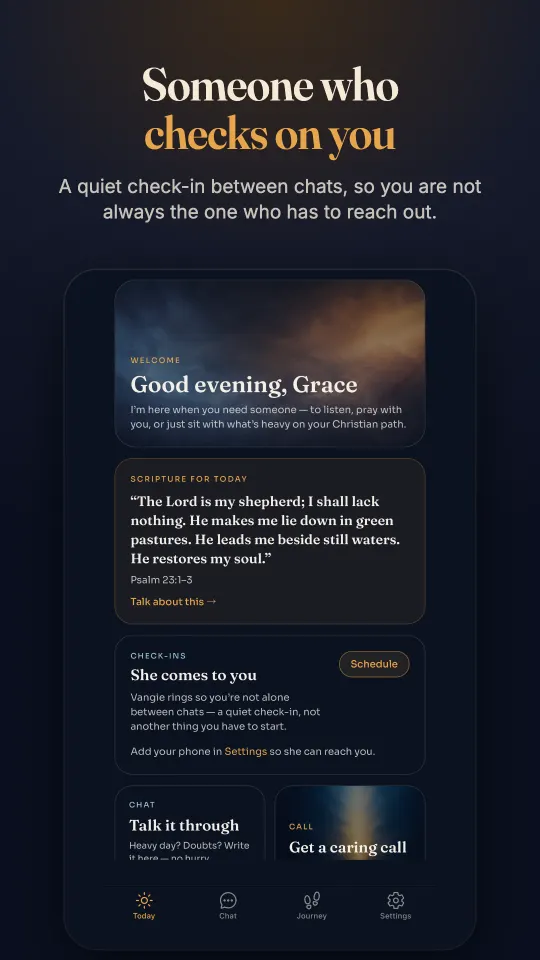
Someone who checks on you
Vangie can be your devotional partner. Each day the Today screen opens with a Scripture for today from your own tradition, and you can tap to talk about it. She can share a short passage on whatever you're facing, searching scripture rather than quoting from memory, ask what stood out to you, and pray with you, by chat or on a gentle phone call. You can schedule a check-in call for your devotional time so there's someone on the other end, and she remembers what you're praying for so she can ask how it went. Vangie is an AI companion, not a pastor; she's there to support your faith and your church, not to replace them.
General information, not medical or mental health advice. Vangie is an AI companion: not a licensed counsellor, therapist, doctor or member of the clergy, and not an emergency service. If you are worried about your mental health, talk to your GP or doctor; in the UK, NHS 111 can help if you need urgent help but it isn't an emergency.