
How to pray and read the Bible
The ACTS prayer method: Adoration, Confession, Thanksgiving, Supplication
ACTS is a simple pattern for prayer: Adoration (praising God for who he is), Confession (admitting where you've gone wrong), Thanksgiving (thanking him for what he has done) and Supplication (asking for what you and others need). It gives shape to your prayers so they don't become only a list of requests.
Bible verses
“Great is the LORD, and greatly to be praised! His greatness is unsearchable.”
Psalm 145:3
Adoration: praising God's greatness, which no one can fully measure.
“If we confess our sins, he is faithful and righteous to forgive us the sins and to cleanse us from all unrighteousness.”
1 John 1:9
Confession: the promise that God is faithful to forgive when we confess our sins.
“Enter into his gates with thanksgiving, and into his courts with praise. Give thanks to him, and bless his name.”
Psalm 100:4
Thanksgiving: entering God's presence with thanks and praise.
“Always rejoice. Pray without ceasing. In everything give thanks, for this is the will of God in Christ Jesus towards you.”
1 Thessalonians 5:16-18
Giving thanks in all circumstances, as part of a life of constant prayer.
“In nothing be anxious, but in everything, by prayer and petition with thanksgiving, let your requests be made known to God.”
Philippians 4:6
Supplication: bringing every request to God, with thanksgiving, instead of anxiety.
“Ask, and it will be given you. Seek, and you will find. Knock, and it will be opened for you.”
Matthew 7:7
Jesus' encouragement to ask, seek and knock: God invites our requests.
Bible quotations are from the World English Bible (British Edition), which is in the public domain.
A prayer you can pray
An ACTS prayer you can pray today
Adoration: God, you are good, patient and faithful. You made everything I see, and you still know my name.
Confession: I'm sorry for the sharp words I said, for the times I ignored you, and for worrying instead of trusting. Please forgive me and help me do better.
Thanksgiving: Thank you for my family, for food on the table, for getting through this week, and for the people who have been kind to me.
Supplication: Please give me wisdom for the decision ahead, strength for tomorrow, and healing for my friend who is unwell. Be close to everyone who is lonely tonight. Amen.
Why use a pattern for prayer?
Left to ourselves, most of our prayers start and end with asking, especially when life is hard. That's not wrong; the Bible is full of people crying out for help. But prayer that is only requests can start to feel like reading a shopping list to God, and we miss the peace that comes from remembering who he is and what he has already done. A simple pattern helps on days when your mind wanders or you don't know where to begin. ACTS is not found as an acronym in the Bible, but each part is: the Psalms are full of praise and thanks, and the Bible models honest confession and bold asking. It's a scaffold, not a rule.
How to pray with ACTS
- 01
A: Adoration
Begin by praising God for who he is: loving, faithful, holy, merciful, creator. Use a Psalm to help, such as Psalm 145 or Psalm 103. This sets everything else in perspective.
- 02
C: Confession
Be honest about where you've fallen short in thought, word or action, and ask for forgiveness. Keep it specific and simple. Many Christians also find it helpful to sit in silence and let things come to mind.
- 03
T: Thanksgiving
Thank God for specific things: answered prayers, people, daily needs met, small moments of joy. Thanks for forgiveness flows naturally from confession.
- 04
S: Supplication
Ask for what you need and pray for others by name: family, friends, your church, your community, people who are struggling, leaders and the world. Supplication is simply an old word for humble asking.
- 05
Try a five-minute version
Spend about a minute on each letter, then one minute in silence at the end. On busy days, even one sentence per letter is a real prayer.
- 06
Write it down
Keeping ACTS prayers in a notebook lets you look back on what you asked for and notice how prayers were answered over time.
Across Christian traditions
- Evangelical and Protestant
- ACTS is widely taught in evangelical churches, youth groups and small groups as an easy introduction to balanced prayer.
- Catholic
- The same movements appear in the Mass: the Gloria (adoration), the Penitential Act (confession), the Eucharistic Prayer (thanksgiving) and the Prayers of the Faithful (supplication). Personal confession also has a sacramental form in Reconciliation.
- Anglican
- Morning and Evening Prayer move through confession, psalms of praise, thanksgiving and intercessions, a structured form of the same pattern.
- Orthodox
- Daily prayers combine praise of the Trinity, repentance (often through the Jesus Prayer), thanksgiving and intercession for the living and the departed.
What tends not to work
Treating ACTS as a box-ticking exercise. If you spend all your time in thanksgiving one day, that's fine.
Rushing past confession. It's often the part that brings the most peace.
Forgetting to pray for other people in supplication. Intercession for others is one of the oldest forms of Christian prayer.
Common questions
What does ACTS stand for in prayer?
Adoration, Confession, Thanksgiving and Supplication: praising God, confessing sin, thanking him, and asking for what you and others need.
Is the ACTS prayer method in the Bible?
The acronym isn't, but each element is found throughout scripture, especially in the Psalms and in Jesus' teaching on prayer. It's a modern teaching aid built on biblical patterns.
How long should an ACTS prayer be?
As long or short as you like. Five minutes, about a minute per part plus a minute of silence, is a good starting point.
How is ACTS different from the Lord's Prayer?
The Lord's Prayer is the prayer Jesus taught, with its own structure of praise, surrender, requests and forgiveness. ACTS is a simpler modern pattern. Many people use both.
Where Vangie fits
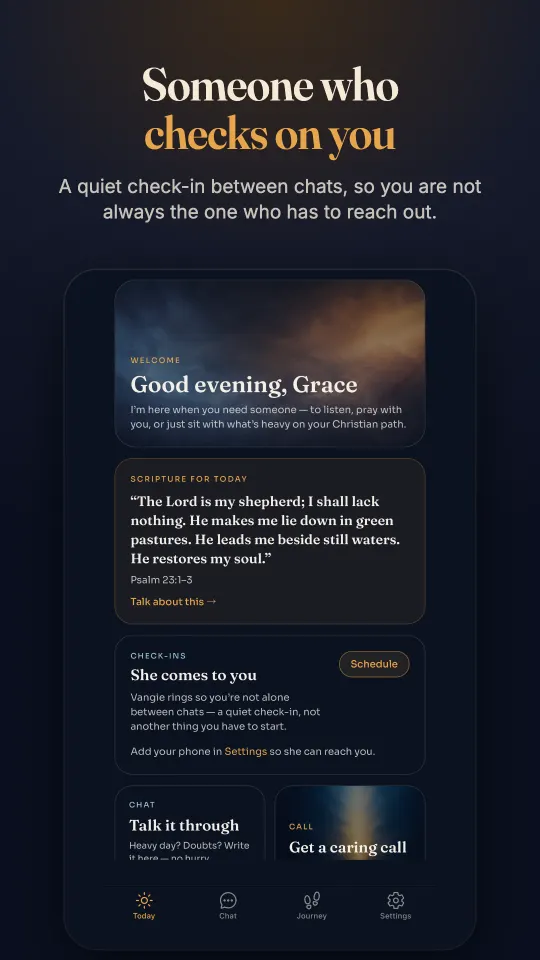
Someone who checks on you
Vangie can walk through ACTS with you when you're getting started. Choose Christian as your tradition, and you can ask her for a Psalm of praise to begin with; she searches scripture rather than quoting from memory. She can help you put thanks and requests into words, pray with you by chat or on a gentle phone call, and remember what you asked for, saving your prayers in your Journey so she can ask later how things turned out. Vangie is an AI companion, not a pastor or priest, and confession to her is not a sacrament.
General information, not medical or mental health advice. Vangie is an AI companion: not a licensed counsellor, therapist, doctor or member of the clergy, and not an emergency service. If you are worried about your mental health, talk to your GP or doctor; in the UK, NHS 111 can help if you need urgent help but it isn't an emergency.