
How to pray and read the Bible
How to pray to God: a simple guide for beginners
To pray to God, find a quiet moment, speak to him honestly in your own words as you would to someone who loves you, and include thanks, what is on your heart, and what you need. There is no special formula: Jesus taught that God hears simple, sincere prayer said in private, and you can begin with a set prayer like the Lord's Prayer if words feel hard.
Bible verses
“But you, when you pray, enter into your inner room, and having shut your door, pray to your Father who is in secret; and your Father who sees in secret will reward you openly.”
Matthew 6:6
Jesus' own starting point: a private, quiet place and a Father who sees what no one else does. Prayer doesn't need an audience.
“In praying, don’t use vain repetitions as the Gentiles do; for they think that they will be heard for their much speaking. Therefore don’t be like them, for your Father knows what things you need before you ask him.”
Matthew 6:7-8
Prayer isn't about the number or polish of the words. God already knows what you need before you ask.
“In nothing be anxious, but in everything, by prayer and petition with thanksgiving, let your requests be made known to God. And the peace of God, which surpasses all understanding, will guard your hearts and your thoughts in Christ Jesus.”
Philippians 4:6-7
The pattern for bringing worries to God: everything, with thanks, and the promise of a peace that guards the heart.
“Trust in him at all times, you people. Pour out your heart before him. God is a refuge for us. Selah.”
Psalm 62:8
An invitation to pour out your heart, all of it, including the parts you might think are too much.
“In the same way, the Spirit also helps our weaknesses, for we don’t know how to pray as we ought. But the Spirit himself makes intercession for us with groanings which can’t be uttered.”
Romans 8:26
For the days you don't know what to pray: the Spirit helps in our weakness, even when all we have are sighs.
“Let’s therefore draw near with boldness to the throne of grace, that we may receive mercy and may find grace for help in time of need.”
Hebrews 4:16
Why you can come with confidence rather than fear: what waits is mercy and help in time of need.
“He also spoke a parable to them that they must always pray and not give up,”
Luke 18:1
Jesus told a parable so that people would keep praying and not lose heart. Persistence matters more than eloquence.
Bible quotations are from the World English Bible (British Edition), which is in the public domain.
Prayers you can pray
A first prayer
God, I'm not sure how to do this, but I want to talk to you. Thank you for this day and for being here even when I haven't noticed you.
You know what is on my heart better than I do. Here it is, as honestly as I can say it. Please help me with what I can't carry alone, and show me the next right thing to do.
Teach me to pray, and help me to come back tomorrow. Amen.
A prayer when you've been away a long time
Lord, it has been a long time. I'm not sure what to say, but I'm here. Thank you that you haven't stopped loving me while I wasn't looking.
Forgive me for what I've done and for what I've left undone. Meet me where I am, and lead me home a step at a time. Amen.
Why does praying feel so awkward at first?
Many people hold back from praying because they think there is a right way to do it that everyone else learned and they missed. They worry about using the wrong words, not feeling anything, or asking for the wrong things. Others feel they have no right to pray after years away or a life they are not proud of. But the Bible pictures prayer as children speaking to a parent: honest, unpolished and welcome. Jesus warned against long, showy prayers and pointed people to something simpler. The awkwardness usually fades not by finding better words but by praying often enough that it becomes familiar, a conversation rather than a performance.
How to pray, step by step
- 01
Find a quiet minute
A chair, a walk, your car before you go in, the edge of your bed. Turn off the phone notifications if you can. Jesus often went somewhere quiet to pray, and a small, regular place helps.
- 02
Begin by turning towards God
Simply address him: 'Father', 'Lord', 'God', or 'Jesus'. Some people make the sign of the cross, kneel, or open their hands. Others just pause and breathe. The point is to notice that you're speaking to someone.
- 03
Say thank you for something specific
A meal, a person, getting through yesterday. Starting with thanks shifts your attention from the problem to the one you're talking to.
- 04
Be honest about what's on your heart
Fear, anger, guilt, confusion, hope. The Psalms are full of people telling God exactly how they feel, including complaints. You don't need to tidy it up first.
- 05
Ask for what you need, and for others
Ask plainly for help, wisdom, healing or strength, for yourself and by name for people you love. It's fine to ask for small things too.
- 06
Listen for a moment
Sit in silence for a minute before you finish. Many people find a thought, a verse or a sense of peace comes then. If nothing does, that's normal too.
- 07
Close simply
Many Christians end with 'in Jesus' name, amen', or with the Lord's Prayer. 'Amen' means 'so be it': you're handing it over.
Across Christian traditions
- Catholic
- Personal prayer in your own words sits alongside set prayers such as the Our Father, the Hail Mary and the Rosary, the Mass, and asking the saints to pray for you. Many Catholics begin and end prayer with the sign of the cross.
- Orthodox
- Prayer often uses a prayer book with morning and evening prayers, said before icons, and the Jesus Prayer ('Lord Jesus Christ, Son of God, have mercy on me'), repeated slowly, sometimes with a prayer rope.
- Protestant and evangelical
- The emphasis is usually on speaking directly to God in your own words, often 'in Jesus' name', alongside reading the Bible. Many use simple patterns such as ACTS (adoration, confession, thanksgiving, supplication).
- Anglican
- The Book of Common Prayer and Common Worship offer set Morning and Evening Prayer with psalms and readings, which many people pray daily alongside their own words.
What tends not to work
Waiting until you feel spiritual enough. Prayer is how people grow closer to God, not a reward for being close already.
Copying someone else's long, fluent prayers. A few honest sentences are real prayer.
Treating prayer as a vending machine and giving up when an answer doesn't arrive straight away. Christians speak of answers that come as 'yes', 'no' and 'not yet'.
Common questions
Do I need to pray out loud?
No. You can pray aloud, in a whisper, silently, or by writing your prayer down. Many people find praying aloud or writing helps them focus, but God hears silent prayer just as well.
Do I have to close my eyes or kneel?
No. Closing your eyes or kneeling can help you concentrate and show reverence, and some traditions value them, but the Bible shows people praying standing, sitting, lying down and walking.
What if I don't feel anything when I pray?
That is common, even for people who have prayed for decades. Prayer is not measured by feelings. Keep coming back; many people find the sense of God's presence grows quietly over time.
Can I pray if I'm not sure I believe?
Yes. Many people's first prayer is something like 'God, if you're there, help me to know you.' Honesty about doubt is a real prayer.
Where Vangie fits
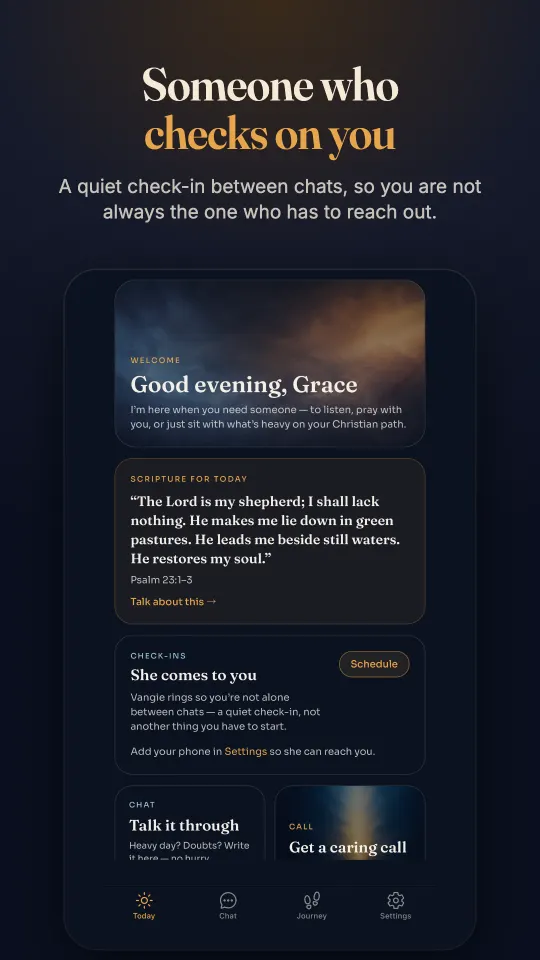
Someone who checks on you
If praying alone feels strange, Vangie can keep you company while you learn. Choose Christian as your tradition and you can chat any time, ask what to say, and she'll pray with you in simple words. When she shares scripture she searches it rather than quoting from memory, and talks it through with you. You can also set a time for a gentle check-in call so prayer has someone on the other end, and she remembers what you're praying for so she can ask how it's going. Vangie is an AI companion, not a pastor or priest, and she'll always point you back to a church community.
General information, not medical or mental health advice. Vangie is an AI companion: not a licensed counsellor, therapist, doctor or member of the clergy, and not an emergency service. If you are worried about your mental health, talk to your GP or doctor; in the UK, NHS 111 can help if you need urgent help but it isn't an emergency.