
Bible verses and what the Bible says
Bible verses about trusting God
The best-known Bible verses about trusting God are Proverbs 3:5–6, Psalm 56:3–4 and Isaiah 26:3–4. Together they say trust is a choice made in the middle of fear and uncertainty, not a feeling you wait for, and that God can be relied on when your own understanding runs out.
11 Bible verses about trusting God, with context
“Trust in the LORD with all your heart, and don’t lean on your own understanding. In all your ways acknowledge him, and he will make your paths straight.”
Proverbs 3:5-6
The most quoted verse on trust: lean on God rather than your own understanding, and he will guide your way. Proverbs is practical wisdom, written to be lived day to day.
“When I am afraid, I will put my trust in you. In God, I praise his word. In God, I put my trust. I will not be afraid. What can flesh do to me?”
Psalm 56:3-4
David admits he is afraid and decides to trust anyway. A favourite for anyone who feels fear and faith at the same time.
“You will keep whoever’s mind is steadfast in perfect peace, because he trusts in you. Trust in the LORD forever; for in the LORD, the LORD, is an everlasting Rock.”
Isaiah 26:3-4
Perfect peace for the mind that stays fixed on God, who is called an everlasting Rock. Part of a song of trust sung by God's people.
“Blessed is the man who trusts in the LORD, and whose confidence is in the LORD. For he will be as a tree planted by the waters, who spreads out its roots by the river, and will not fear when heat comes, but its leaf will be green, and will not be concerned in the year of drought. It won’t cease from yielding fruit.”
Jeremiah 17:7-8
The person who trusts God is pictured as a tree planted by water that keeps its leaves in heat and drought. Trust doesn't remove hard seasons; it roots you through them.
“Trust in the LORD, and do good. Dwell in the land, and enjoy safe pasture. Also delight yourself in the LORD, and he will give you the desires of your heart. Commit your way to the LORD. Trust also in him, and he will do this: he will make your righteousness shine out like light, and your justice as the noon day sun.”
Psalm 37:3-6
Trust, do good, delight in God and commit your way to him. A steadying psalm for when other people seem to prosper unfairly.
“Those who know your name will put their trust in you, for you, LORD, have not forsaken those who seek you.”
Psalm 9:10
Those who know God's name put their trust in him, because he has not forsaken those who seek him.
“Trust in him at all times, you people. Pour out your heart before him. God is a refuge for us. Selah.”
Psalm 62:8
An invitation to trust God at all times and pour out your heart before him. Trust and honest prayer belong together.
“Behold, God is my salvation. I will trust, and will not be afraid; for the LORD, the LORD, is my strength and song; and he has become my salvation.”
Isaiah 12:2
A song of thanks: God is my salvation, I will trust and not be afraid. Often prayed as a short declaration.
“The LORD is good, a stronghold in the day of trouble; and he knows those who take refuge in him.”
Nahum 1:7
God is good, a stronghold in the day of trouble, and he knows those who take refuge in him. A single line of comfort from a little-read prophet.
“Some trust in chariots, and some in horses, but we trust in the name of the LORD our God.”
Psalm 20:7
Some trust in chariots and horses, but we trust in the name of God. A reminder that our usual sources of security are not the last word.
“Now faith is assurance of things hoped for, proof of things not seen.”
Hebrews 11:1
The Bible's short definition of faith: being sure of what is hoped for and convinced of what isn't seen. The chapter goes on to tell stories of people who trusted without seeing the end.
Bible quotations are from the World English Bible (British Edition), which is in the public domain.
A prayer you can pray
A prayer for when it's hard to trust
Lord, I want to trust you, and I'm also afraid. I can't see how this will turn out, and I keep trying to hold it all myself.
Take what I can't carry. Where I don't understand, be my understanding. Where I am anxious, be my peace. I choose today to lean on you again, even if I have to choose it again tomorrow. Amen.
Why is trusting God so hard when you need it most?
Trust is easy to talk about when things are going well and hard to practise when they aren't. Uncertainty makes us want control, and when we can't get it, worry fills the gap. Many people also carry an unspoken fear that trusting God means pretending to feel calm, or that doubt cancels out faith. The Bible is more honest than that. The psalmists say they are afraid and choose to trust in the same breath, and many of these verses were written by people in real danger, exile or grief. Trust in scripture is less a mood than a direction: turning towards God again and again, especially on the days you feel least sure.
How to lean on these verses
- 01
Say the fear out loud first
Psalm 56 starts with 'when I am afraid'. Name what you're afraid of before you pray the verse; trust grows from honesty, not from pretending.
- 02
Choose one verse for the week
Write Proverbs 3:5–6 or Psalm 56:3 on a card and read it each morning. One verse lived with is worth more than ten skimmed.
- 03
Read the whole chapter
Psalm 37 and Jeremiah 17 make more sense in context. Notice who is speaking and what they are going through.
- 04
Do the next small thing
Trust in scripture usually goes with action: doing good, making the call, taking the step you can. Trust God with the outcome, not with the work you can do today.
What tends not to work
Treating doubt as proof you don't trust God. The Psalms are full of people who doubted and kept praying.
Using 'just trust God' to dismiss someone's real problem. Trust and practical help go together.
Reading Jeremiah 29:11-style promises as guarantees of a particular outcome. Many of these verses promise God's presence, not an easy road.
Common questions
What is the most famous Bible verse about trusting God?
Proverbs 3:5–6 is the best known, followed closely by Psalm 56:3 and Isaiah 26:3. All three are short enough to memorise.
How do you trust God when you're anxious?
Many Christians start by telling God plainly what they're anxious about, then praying a verse such as Psalm 56:3 back to him. If anxiety is constant or overwhelming, talk to a doctor too; faith and good care work together.
Is it a sin to doubt God?
Christians answer this in different ways, but the Bible itself is full of honest doubters, from the psalmists to Thomas. Most traditions treat doubt as part of a living faith rather than the end of it.
What does 'lean not on your own understanding' mean?
Proverbs 3:5 isn't telling you to stop thinking. It means not making your own understanding the final authority, especially when you can't see the whole picture.
Where Vangie fits
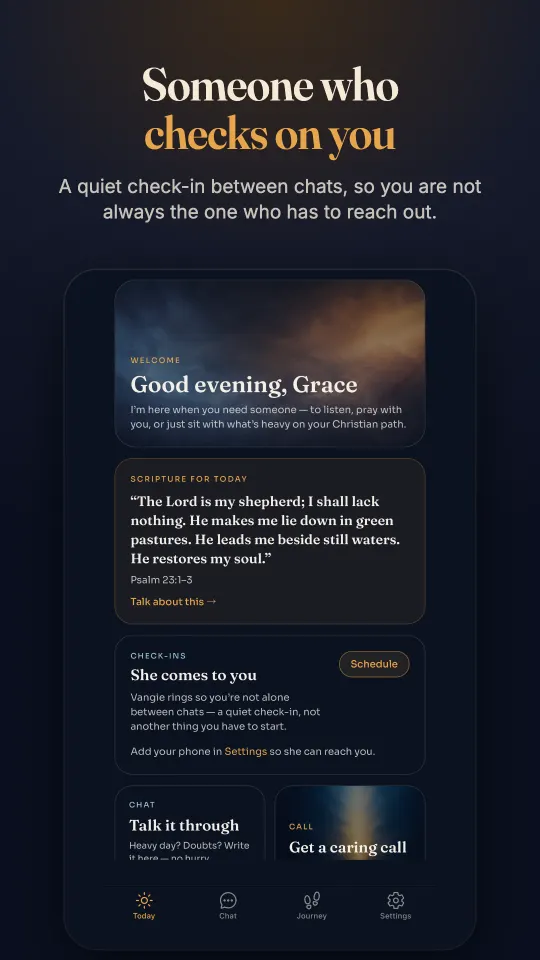
Someone who checks on you
Vangie is an AI companion you can talk to any time by chat, or by a gentle phone call that listens first and can end with prayer. Choose Christian as your tradition and, when you ask for a verse, she searches scripture for one that fits what you're facing rather than quoting from memory, then talks it through with you. She keeps what you're praying for in your Journey and asks how it's going next time, opens each day with a Scripture for today on the Today screen, and can call you for a check-in at a time you choose. She isn't a pastor or a crisis line, and works best alongside your church and the people around you.
General information, not medical or mental health advice. Vangie is an AI companion: not a licensed counsellor, therapist, doctor or member of the clergy, and not an emergency service. If you are worried about your mental health, talk to your GP or doctor; in the UK, NHS 111 can help if you need urgent help but it isn't an emergency.