
How to pray and read the Bible
The Daily Examen: Ignatius's 5-step prayer
The Daily Examen is a short prayer from St Ignatius of Loyola for looking back over your day with God. In its most common form it has five steps: become aware of God's presence, give thanks, ask for light, review the day honestly, and look ahead to tomorrow. It takes about 10 to 15 minutes and is usually prayed in the evening.
Bible verses
“Search me, God, and know my heart. Try me, and know my thoughts. See if there is any wicked way in me, and lead me in the everlasting way.”
Psalm 139:23-24
The psalmist invites God to search his heart, know his thoughts and lead him in the everlasting way.
“It is because of The LORD’s loving kindnesses that we are not consumed, because his mercies don’t fail. They are new every morning. Great is your faithfulness.”
Lamentations 3:22-23
God's loving kindnesses never fail and his mercies are new every morning, a hopeful note for the end of the Examen.
“Always rejoice. Pray without ceasing. In everything give thanks, for this is the will of God in Christ Jesus towards you.”
1 Thessalonians 5:16-18
Paul's call to rejoice always, pray continually and give thanks in all circumstances.
“Let us search and try our ways, and turn again to the LORD.”
Lamentations 3:40
An invitation to search and test our ways and return to the LORD, which captures the review step of the Examen.
Bible quotations are from the World English Bible (British Edition), which is in the public domain.
Prayers you can pray
A prayer to begin the Examen
Lord, you were with me in every hour of today, even the ones I've already forgotten. Help me to look back with you, to notice your gifts, to see my mistakes honestly, and to trust you with tomorrow. Amen.
A prayer to end the Examen
Thank you for today, Lord: for what went well, for what I learned, and for your mercy where I fell short. Tomorrow is yours. Give me the grace I need for it, and let me rest now in your care. Amen.
Why looking back helps you see God in ordinary days
Days blur together. Without a pause, the good moments are forgotten and the hard ones fester. St Ignatius, the 16th-century founder of the Jesuits, taught the Examen in his Spiritual Exercises and considered it so important that he asked his companions never to skip it, even when they had to drop other prayers. Its power is in its simplicity: noticing where you felt close to God and where you felt far away, giving thanks, owning your mistakes without drowning in them, and asking for help with tomorrow. Over weeks, people often start to see patterns: what gives them life, what drains them, and where God has been quietly present all along.
How to pray the Examen in 5 steps
- 01
1. Become aware of God's presence
Sit quietly and remind yourself that God is with you now and was with you all day. Ask for the grace to see your day as God sees it.
- 02
2. Give thanks
Recall two or three specific gifts from the day: a conversation, a meal, a moment of beauty, help you received. Thank God for each one.
- 03
3. Ask for light
Ask the Holy Spirit to help you look back honestly, without excuses and without harshness.
- 04
4. Review the day
Walk through the day hour by hour. Where did you feel most alive and close to God? Where did you feel restless, drained or far away? Notice where you fell short and ask for forgiveness.
- 05
5. Look toward tomorrow
Think about the day ahead. Ask for the specific grace you need: patience in a meeting, courage for a conversation, rest. End with the Lord's Prayer or your own words.
Across Christian traditions
- Catholic and Jesuit
- The Examen is a cornerstone of Ignatian spirituality. Jesuits pray it daily, and Jesuit schools and parishes often teach it to students and families.
- Anglican and Protestant
- Many Anglicans, Methodists and evangelicals use the Examen or similar evening reviews; John Wesley's practice of daily self-examination has a similar spirit.
- Without a set form
- Some people simply ask two questions each night: what am I most grateful for today, and what am I least grateful for? This "consolation and desolation" version is a common way in.
What tends not to work
Turning the review into a list of failures. Ignatius put thanksgiving before review on purpose.
Skipping the look ahead. Asking for help with tomorrow is what turns reflection into change.
Doing it in bed when you're already falling asleep. Try just before you start getting ready for bed.
Common questions
What is the difference between the Examen and confession?
The Examen is a daily personal prayer of reflection that includes thanksgiving, review and looking ahead. Confession, for Catholics and Orthodox, is a sacrament with a priest. Many people find the Examen helps them prepare for confession, but it is not a replacement for it.
How long does the Daily Examen take?
Usually 10 to 15 minutes. On busy days, even three minutes spent on thanks and one moment to review is worthwhile.
Can I pray the Examen in the morning?
Yes. Some people review the previous day in the morning. Ignatius himself suggested praying it at midday as well as in the evening.
Where does the Examen come from?
St Ignatius of Loyola described it in his Spiritual Exercises, first published in 1548. It has been central to Jesuit life ever since.
Where Vangie fits
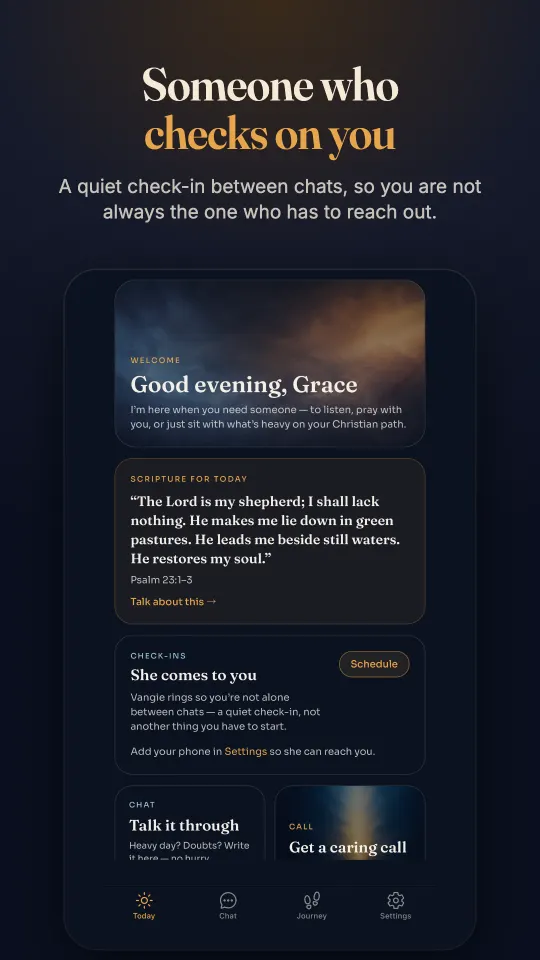
Someone who checks on you
Vangie can be a gentle partner for a practice like this. Choose your tradition and she meets you there: she can share a short passage, found by search rather than quoted from memory, ask what stood out to you, and pray with you by chat or at the end of a gentle phone call. You can schedule check-in calls for the time you usually pray, so the habit has someone on the other end, and she keeps what you're praying for in your Journey so she can ask how it's going. She is an AI companion, not a spiritual director, pastor or priest.
General information, not medical or mental health advice. Vangie is an AI companion: not a licensed counsellor, therapist, doctor or member of the clergy, and not an emergency service. If you are worried about your mental health, talk to your GP or doctor; in the UK, NHS 111 can help if you need urgent help but it isn't an emergency.