
How to pray and read the Bible
Lectio Divina: how to pray with Scripture in 4 steps
Lectio Divina (Latin for "divine reading") is a slow, prayerful way of reading Scripture in four steps: lectio (read a short passage slowly), meditatio (reflect on a word or phrase that stands out), oratio (respond to God in prayer) and contemplatio (rest quietly in God's presence). It comes from the monastic tradition and can be done in 10 to 20 minutes.
Bible verses
“Your word is a lamp to my feet, and a light for my path.”
Psalm 119:105
The psalmist calls God's word a lamp for his feet and a light for his path, an image of Scripture guiding daily life.
“Blessed is the man who doesn’t walk in the counsel of the wicked, nor stand on the path of sinners, nor sit in the seat of scoffers; but his delight is in the LORD’s law. On his law he meditates day and night. He will be like a tree planted by the streams of water, that produces its fruit in its season, whose leaf also does not wither. Whatever he does shall prosper.”
Psalm 1:1-3
The person who delights in God's law and meditates on it day and night is pictured as a tree planted by streams of water.
“This book of the law shall not depart from your mouth, but you shall meditate on it day and night, that you may observe to do according to all that is written in it; for then you shall make your way prosperous, and then you shall have good success.”
Joshua 1:8
Joshua is told to keep God's law on his lips and meditate on it day and night, an early picture of slow, repeated reading.
“As they went on their way, he entered into a certain village, and a certain woman named Martha received him into her house. She had a sister called Mary, who also sat at Jesus’ feet and heard his word. But Martha was distracted with much serving, and she came up to him, and said, “Lord, don’t you care that my sister left me to serve alone? Ask her therefore to help me.” Jesus answered her, “Martha, Martha, you are anxious and troubled about many things, but one thing is needed. Mary has chosen the good part, which will not be taken away from her.””
Luke 10:38-42
Mary sits at Jesus's feet listening while Martha is busy with preparations, and Jesus says Mary has chosen what is better.
““Be still, and know that I am God. I will be exalted amongst the nations. I will be exalted in the earth.””
Psalm 46:10
God's call to be still and know that he is God, often used to describe the final, quiet step of the practice.
Bible quotations are from the World English Bible (British Edition), which is in the public domain.
Prayers you can pray
A prayer before Lectio Divina
Lord, I want to hear you, not just read about you. Quiet the noise in me. As I read these words, let one of them reach me, and help me to answer you honestly. Amen.
A prayer to close
Thank you for speaking, even in a single word. Help me to carry it with me today, and to come back tomorrow and listen again. Amen.
Why reading slowly changes how Scripture lands
Most of us read to get information, quickly and in large amounts. Lectio Divina asks for the opposite: a few verses, read several times, with long pauses. The aim is not to master a passage but to let one word or phrase meet you where you are and become the starting point for prayer. The practice goes back to the early monks and was built into Benedictine life through St Benedict's Rule. In the 12th century, a Carthusian monk called Guigo II described it as a ladder with four rungs, the four steps still used today. Many people find it helps when Bible reading has become dry or academic, because it turns reading into conversation.
How to do Lectio Divina, step by step
- 01
Prepare: choose a short passage and settle
Pick four to eight verses, for example one of the Psalms or a Gospel story. Sit somewhere quiet, take a few slow breaths and ask God to speak to you through the reading.
- 02
1. Lectio: read
Read the passage slowly, ideally aloud. Read it again. Notice any word or phrase that catches your attention, without analysing why.
- 03
2. Meditatio: reflect
Read it a second or third time and stay with that word or phrase. Repeat it gently. Ask what it brings to mind about your life today.
- 04
3. Oratio: respond
Talk to God about what you noticed: thanks, a question, a confession, a request. Use your own words, as honestly as you can.
- 05
4. Contemplatio: rest
Stop talking and simply rest in God's presence for a few minutes. If your mind wanders, return to your word or phrase.
- 06
Carry one word into the day
Many people end by choosing one phrase to carry with them, writing it down or saying it again at lunch or before sleep.
Across Christian traditions
- Catholic and monastic
- Lectio Divina is at the heart of Benedictine monastic life and is warmly encouraged for all Catholics. Many parishes run group Lectio using the Sunday Gospel.
- Anglican and Protestant
- Anglicans, Methodists and many evangelicals use it too, sometimes under names like "devotional reading" or "praying the Scriptures", often in small groups.
- Orthodox
- Orthodox Christians have their own long tradition of slow, prayerful reading of Scripture and the Church Fathers, alongside the Jesus Prayer.
What tends not to work
Choosing a long passage. A few verses is plenty; the practice works by slowing down.
Turning it into Bible study. Commentary and cross-references are valuable, but save them for another time.
Feeling you've failed if nothing stands out. Sometimes the fruit of the practice is simply the quiet.
Common questions
How long should Lectio Divina take?
Anything from 10 to 30 minutes. Beginners often start with about 15 minutes: a few minutes each for reading, reflecting and responding, and a few in silence.
Which Bible passages are best for Lectio Divina?
Short, vivid passages work well: a Psalm such as Psalm 23 or Psalm 46, a Gospel story such as Mary and Martha in Luke 10, or a few verses from one of Paul's letters.
Can Lectio Divina be done in a group?
Yes. A leader reads the passage aloud several times, each person shares the word that stood out (or passes), then the group prays and sits in silence together.
Who was Guigo II?
A 12th-century Carthusian monk whose short work, often called The Ladder of Monks, described the four steps of reading, meditation, prayer and contemplation that are still used today.
Where Vangie fits
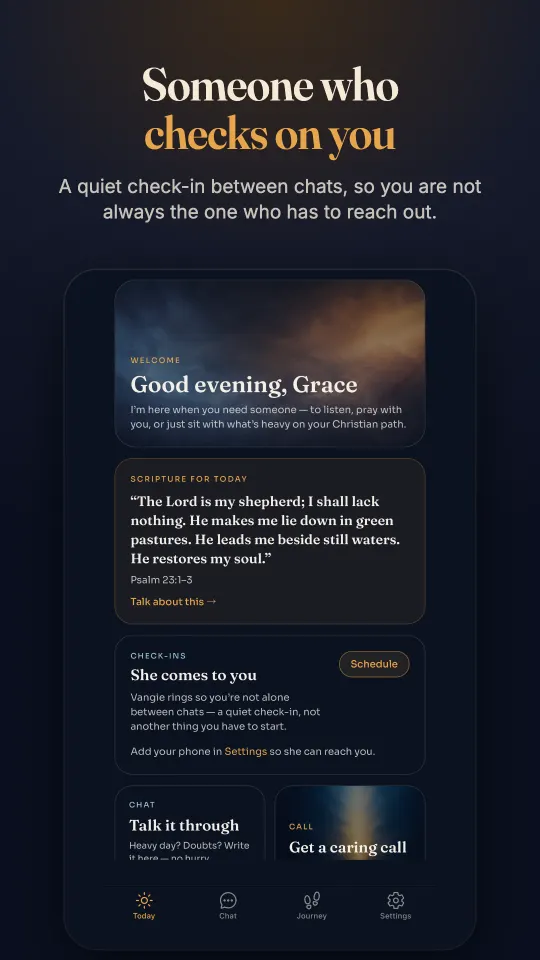
Someone who checks on you
Vangie can be a gentle partner for a practice like this. Choose your tradition and she meets you there: she can share a short passage, found by search rather than quoted from memory, ask what stood out to you, and pray with you by chat or at the end of a gentle phone call. You can schedule check-in calls for the time you usually pray, so the habit has someone on the other end, and she keeps what you're praying for in your Journey so she can ask how it's going. She is an AI companion, not a spiritual director, pastor or priest.
General information, not medical or mental health advice. Vangie is an AI companion: not a licensed counsellor, therapist, doctor or member of the clergy, and not an emergency service. If you are worried about your mental health, talk to your GP or doctor; in the UK, NHS 111 can help if you need urgent help but it isn't an emergency.