
Muslim, Jewish, Hindu, Sikh and Buddhist prayers
Gayatri Mantra: words and meaning
The Gayatri Mantra is a Vedic prayer from the Rig Veda (3.62.10) addressed to Savitr, the divine light of the sun: "Om bhur bhuvah svah, tat savitur varenyam, bhargo devasya dhimahi, dhiyo yo nah prachodayat." It is usually translated as "We meditate on the adorable radiance of the divine light; may it illuminate our minds."
Prayers you can pray
The Gayatri Mantra (transliteration)
Om bhur bhuvah svah, tat savitur varenyam, bhargo devasya dhimahi, dhiyo yo nah prachodayat.
A common English rendering
We meditate on the adorable radiance of the divine light, the source of the earth, the atmosphere and the heavens. May that light inspire and illuminate our minds.
Why a short mantra is so central
The Gayatri Mantra is among the most revered verses in Hindu tradition, recited daily by millions, often at sunrise and sunset. It is not a request for things but for clarity: that the divine light would awaken and guide the mind. Because it is short, it is easy to learn, but its brevity can make it easy to recite without attention. Traditional practice joins it to the breath and the day's rhythm, at the junctions of the day (sandhya), and repeats it many times, often 108 on a mala, so that the meaning settles. Different traditions within Hinduism also hold different views about who should chant it and how it is taught, so it helps to know the background as well as the words.
The meaning, phrase by phrase
- 01
Om bhur bhuvah svah
Om, the sacred sound, followed by the three vyahritis: bhur (the earth), bhuvah (the atmosphere or space between) and svah (the heavens). This opening is added to the Rig Veda verse in recitation.
- 02
Tat savitur varenyam
"That most excellent (varenyam) one of Savitr": Savitr is the divine power of the sun as the source of light and life.
- 03
Bhargo devasya dhimahi
"We meditate (dhimahi) on the radiance (bhargo) of the divine (devasya)."
- 04
Dhiyo yo nah prachodayat
"Who (yo) may inspire or awaken (prachodayat) our (nah) minds or understanding (dhiyo)." The prayer asks not for possessions but for a clear, awakened mind.
- 05
When and how it is chanted
Traditionally at sunrise, noon and sunset (the sandhya times), facing the sun or a lamp, often repeated 108 times on a mala of beads, slowly and with attention to the breath.
Within the tradition
- Traditional Vedic practice
- The mantra is received through the upanayana (sacred thread) initiation and recited as part of daily sandhya vandanam. Some traditions hold that it should be learned from a teacher and chanted with correct Vedic accents.
- Reform movements
- Movements such as the Arya Samaj encouraged everyone, regardless of caste or gender, to recite the Gayatri Mantra, and this wider practice is now common in temples and homes worldwide.
- Devotional use today
- Many Hindus chant or listen to it daily as a prayer for clarity and peace, in morning puja, before study or at the start of the day.
What tends not to work
Racing through 108 repetitions without attention. A few slow, meant recitations count for more.
Treating it as a wish-granting formula. Its request is for an illumined mind.
Assuming every tradition teaches it the same way. Ask your family, temple or teacher how they practise.
Common questions
What is the Gayatri Mantra in simple words?
A prayer to the divine light, symbolised by the sun, asking that it awaken and guide our minds.
Where does the Gayatri Mantra come from?
The Rig Veda, book 3, hymn 62, verse 10, attributed to the sage Vishvamitra. The opening "Om bhur bhuvah svah" is added in recitation.
Why is it chanted 108 times?
108 is a sacred number in many Hindu and Buddhist traditions, and a mala has 108 beads, so many people chant the mantra once per bead.
Who can chant the Gayatri Mantra?
Traditions differ. Some keep it for those who have received initiation from a teacher; others, including many modern movements, encourage everyone to chant it. Follow the guidance of your own family or teacher.
Where Vangie fits
Someone who checks on you
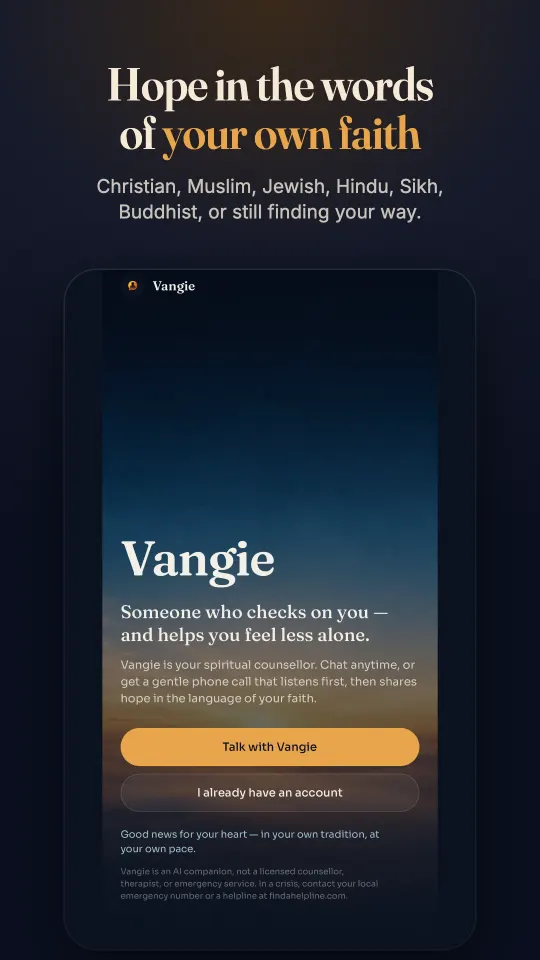
If you choose Hindu as your tradition, Vangie stays within it. She can reflect with you on the Gayatri Mantra or other texts from your tradition, which she finds by search rather than quoting from memory, and she never pushes another path. You can chat any time, or set a gentle check-in call for sunrise or whenever suits you. She is an AI companion, not a priest or guru.
General information, not medical or mental health advice. Vangie is an AI companion: not a licensed counsellor, therapist, doctor or member of the clergy, and not an emergency service. If you are worried about your mental health, talk to your GP or doctor; in the UK, NHS 111 can help if you need urgent help but it isn't an emergency.