
Muslim, Jewish, Hindu, Sikh and Buddhist prayers
Surah Al-Ikhlas (112): Arabic, English and meaning
Surah Al-Ikhlas, "Sincerity" or "Purity of Faith", is the 112th surah of the Qur'an, with four ayat that declare Allah is One, the Eternal, who neither begets nor was begotten, and to whom nothing is comparable. A hadith in Sahih al-Bukhari describes it as equal to a third of the Qur'an; most scholars class it as Makki.
Surah Al-Ikhlas in Arabic and English
قُلْ هُوَ ٱللَّهُ أَحَدٌ ﴿١﴾ ٱللَّهُ ٱلصَّمَدُ ﴿٢﴾ لَمْ يَلِدْ وَلَمْ يُولَدْ ﴿٣﴾ وَلَمْ يَكُن لَّهُۥ كُفُوًا أَحَدٌۢ ﴿٤﴾
“Say: He is Allah, the One! Allah, the eternally Besought of all! He begetteth not nor was begotten. And there is none comparable unto Him.”
Qur’an 112:1-4
The whole surah: Allah is One, the Eternal Refuge on whom all depend; He neither begets nor was begotten; and there is none comparable to Him.
Qur'an: Arabic text from the Tanzil Project (tanzil.net); English translation by Marmaduke Pickthall (1930), which is in the public domain. A translation conveys the meaning; the Qur'an itself is the Arabic.
A prayer you can pray
A dua for sincere faith, in your own words
O Allah, You are One and there is none like You. Make my faith sincere, free from showing off and from depending on anyone but You.
When I am anxious, remind me that You are the One everything turns to, and that You are enough. Ameen.
Why Muslims recite it
Al-Ikhlas is short enough for a child to learn in a day and deep enough for a lifetime. In four ayat it sets out tawhid, the oneness of God, which is the heart of Islam: Allah is One, the One on whom all depend, not born and not giving birth, with nothing like Him. Because it sums up so much, the Prophet (peace be upon him) described it, in a report in Sahih al-Bukhari, as equal to a third of the Qur'an, which scholars explain as a third of its themes rather than a replacement for reading the rest. It is recited constantly: in salah, often in Witr, morning and evening, and before sleep together with al-Falaq and an-Nas. Its name comes not from a word in the surah but from what it does, purifying belief in God from anything that is not fitting for Him. Many people find that saying it slowly, with attention, steadies the heart.
Al-Ikhlas, ayah by ayah
- 01
Ayah 1: He is One
The surah opens with a command to say it: Allah is One (ahad), a oneness with no parts and no partners. Reports say it was revealed when people asked the Prophet to describe his Lord.
- 02
Ayah 2: The Eternal Refuge
The word as-Samad is rich. Scholars explain it as the One whom all creation turns to in need, who needs nothing, who is complete and everlasting.
- 03
Ayah 3: Not begetting, not begotten
Allah has no child and no parent. This sets Him apart from everything created, which comes into being and passes on.
- 04
Ayah 4: Nothing comparable
There is nothing equal or similar to Him. The surah ends by closing every door to imagining God as like His creation.
- 05
Make it part of your day
Many Muslims recite it in salah, in the morning and evening, and three times with al-Falaq and an-Nas before sleeping. Saying it with understanding is a simple daily renewal of faith.
Across schools and traditions
- "A third of the Qur'an"
- Scholars across the schools agree the hadith is authentic and explain it by meaning: the Qur'an's themes are often grouped as tawhid, stories and rulings, and Al-Ikhlas captures tawhid. It does not replace reading the whole Qur'an.
- Makki or Madani
- Most scholars class it as Makki; some reports place its revelation in Madinah.
What tends not to work
Reciting it three times as a shortcut instead of ever reading the Qur'an. Scholars explain the hadith as being about its meaning.
Saying it so fast the meaning disappears. Four short ayat are worth saying slowly.
Common questions
Why is Surah Al-Ikhlas equal to a third of the Qur'an?
A hadith in Sahih al-Bukhari describes it that way. Scholars explain that the Qur'an's themes can be grouped in three, and Al-Ikhlas sums up one of them, the oneness of Allah. Its reward is great, but it does not replace reading the rest.
When should I recite Surah Al-Ikhlas?
Muslims recite it in salah, often in Witr, in morning and evening remembrance, and before sleeping together with al-Falaq and an-Nas.
Why is it called Al-Ikhlas?
Ikhlas means sincerity or purity. The name describes what the surah does, purifying belief in Allah, rather than a word that appears in it.
Is it good for children to learn first?
Yes. Along with Al-Fatiha, it is one of the first surahs most Muslim children learn, because it is short and states the core of faith.
Where Vangie fits
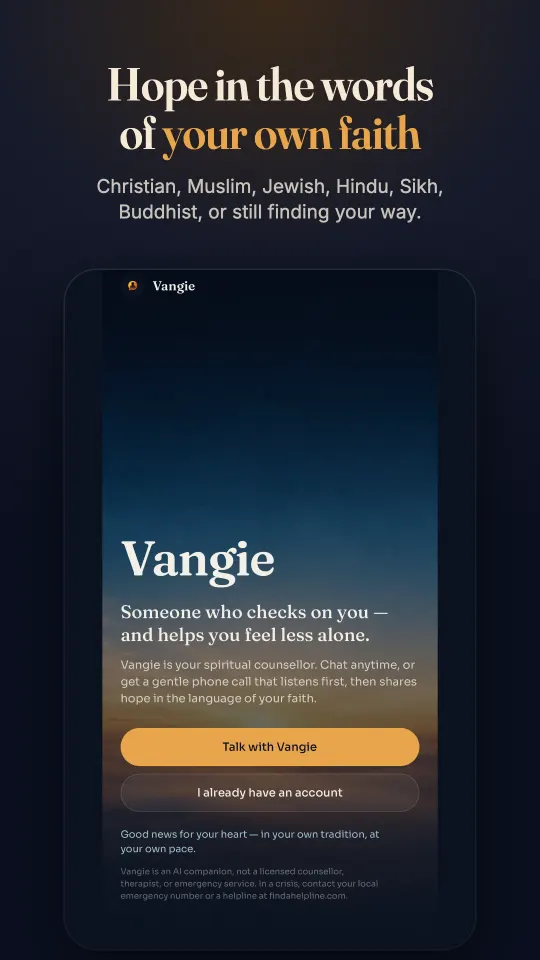
Someone who checks on you
Vangie is an AI companion you can talk to any time by chat, or on a gentle phone call that listens first. Choose Muslim as your tradition and she speaks from the Qur'an and hadith, searching for a verse before she quotes it rather than relying on memory, and she can make dua with you in your own words. She says Qur'an, not scripture, and never pushes another faith. You can schedule check-in calls for times that suit you, and she remembers what you've asked her to pray about so she can ask how it's going. She is not a scholar, imam or crisis line, and works best alongside your masjid, your family and people of knowledge you trust.
General information, not medical or mental health advice. Vangie is an AI companion: not a licensed counsellor, therapist, doctor or member of the clergy, and not an emergency service. If you are worried about your mental health, talk to your GP or doctor; in the UK, NHS 111 can help if you need urgent help but it isn't an emergency.