
Bible verses and what the Bible says
Psalm 37 meaning: do not fret
Psalm 37 is a wisdom psalm attributed to David, written as an older person's advice: don't fret or envy when wrongdoers seem to prosper, because their success is short-lived. Instead trust the LORD, delight in him, commit your way to him, be still and wait, and keep doing good; the meek and the righteous will be upheld.
Psalm 37, the whole psalm
“Don’t fret because of evildoers, neither be envious against those who work unrighteousness. For they shall soon be cut down like the grass, and wither like the green herb.”
Psalm 37:1-2
The opening advice: don't fret or envy wrongdoers, because they will soon wither like grass.
“Trust in the LORD, and do good. Dwell in the land, and enjoy safe pasture. Also delight yourself in the LORD, and he will give you the desires of your heart. Commit your way to the LORD. Trust also in him, and he will do this: he will make your righteousness shine out like light, and your justice as the noon day sun.”
Psalm 37:3-6
What to do instead: trust in the LORD and do good, delight in him, commit your way to him, and he will bring your righteousness out like the light.
“Rest in the LORD, and wait patiently for him. Don’t fret because of him who prospers in his way, because of the man who makes wicked plots happen. Cease from anger, and forsake wrath. Don’t fret; it leads only to evildoing. For evildoers shall be cut off, but those who wait for the LORD shall inherit the land. For yet a little while, and the wicked will be no more. Yes, though you look for his place, he isn’t there. But the humble shall inherit the land, and shall delight themselves in the abundance of peace.”
Psalm 37:7-11
Rest in the LORD and wait patiently; stop being angry; the wicked will be gone, and the humble will inherit the land and enjoy abundant peace.
“The wicked plots against the just, and gnashes at him with his teeth. The Lord will laugh at him, for he sees that his day is coming. The wicked have drawn out the sword, and have bent their bow, to cast down the poor and needy, to kill those who are upright on the path. Their sword shall enter into their own heart. Their bows shall be broken.”
Psalm 37:12-15
The wicked plot and draw swords against the poor and upright, but the Lord laughs at them, and their weapons turn on themselves.
“Better is a little that the righteous has, than the abundance of many wicked. For the arms of the wicked shall be broken, but the LORD upholds the righteous. The LORD knows the days of the perfect. Their inheritance shall be forever. They shall not be disappointed in the time of evil. In the days of famine they shall be satisfied. But the wicked shall perish. The enemies of the LORD shall be like the beauty of the fields. They will vanish— vanish like smoke.”
Psalm 37:16-20
A little with righteousness is better than great wealth with wickedness; the LORD knows the days of the blameless, who will be satisfied even in famine.
“The wicked borrow, and don’t pay back, but the righteous give generously. For such as are blessed by him shall inherit the land. Those who are cursed by him shall be cut off. A man’s steps are established by the LORD. He delights in his way. Though he stumble, he shall not fall, for the LORD holds him up with his hand. I have been young, and now am old, yet I have not seen the righteous forsaken, nor his children begging for bread. All day long he deals graciously, and lends. His offspring is blessed.”
Psalm 37:21-26
The righteous give generously; the LORD establishes a good person's steps and holds them when they stumble; the writer, now old, has not seen the righteous forsaken.
“Depart from evil, and do good. Live securely forever. For the LORD loves justice, and doesn’t forsake his saints. They are preserved forever, but the children of the wicked shall be cut off. The righteous shall inherit the land, and live in it forever. The mouth of the righteous talks of wisdom. His tongue speaks justice. The law of his God is in his heart. None of his steps shall slide. The wicked watch the righteous, and seek to kill him. The LORD will not leave him in his hand, nor condemn him when he is judged.”
Psalm 37:27-33
Turn from evil and do good; the LORD loves justice and won't abandon his faithful; the righteous speak wisdom with God's law in their heart.
“Wait for the LORD, and keep his way, and he will exalt you to inherit the land. When the wicked are cut off, you shall see it. I have seen the wicked in great power, spreading himself like a green tree in its native soil. But he passed away, and behold, he was not. Yes, I sought him, but he could not be found. Mark the perfect man, and see the upright, for there is a future for the man of peace. As for transgressors, they shall be destroyed together. The future of the wicked shall be cut off. But the salvation of the righteous is from the LORD. He is their stronghold in the time of trouble. The LORD helps them and rescues them. He rescues them from the wicked and saves them, because they have taken refuge in him.”
Psalm 37:34-40
Wait for the LORD and keep his way; the wicked who seemed to flourish vanished; there is a future for the person of peace, and the LORD is their stronghold in trouble.
Bible quotations are from the World English Bible (British Edition), which is in the public domain.
A prayer you can pray
A prayer when others seem to win by doing wrong
LORD, you see what I see, and more. I'm angry, and I'm tired of watching wrong get rewarded.
Cool the fire in me before it turns into something I regret. Help me keep doing good when it seems to get me nowhere.
I commit my way to you. Bring out what is right in your time, not mine, and let me rest in that. Amen.
Why do people turn to Psalm 37?
Few things eat at us like watching people cut corners and get ahead while we try to do right and seem to fall behind. A colleague takes credit and gets promoted; someone lies and is believed; a person who hurt you seems to have no consequences. Psalm 37 speaks straight into that feeling, and its first word of advice is about our own inner life: don't fret. In Hebrew the word suggests getting heated, burning up inside. The psalm doesn't deny that injustice is real. It takes the long view instead, comparing quick success built on wrong to grass that withers, and patient goodness to a tree that lasts. It is also one of the acrostic psalms, with sections beginning with successive letters of the Hebrew alphabet, which made it easy to memorise. It reads like a grandparent's counsel to someone young and angry: steady, practical and hopeful.
Psalm 37, section by section
- 01
Verses 1 and 2: don't fret
The psalm starts with your reaction, not theirs. Envy and inner heat hurt you long before they change anything else.
- 02
Verses 3 to 6: four verbs
Trust, delight, commit, and then rest in what God will do. 'Delight yourself in the LORD' is about wanting God first, after which your desires start to change shape.
- 03
Verses 7 to 11: be still and wait
Patience is not passivity; it is refusing to let anger drive you. Verse 11's promise to the humble is the line Jesus echoes in the Beatitudes: blessed are the meek.
- 04
Verses 12 to 20: the long view
Plots fail and short-term gains fade. A little honestly held is worth more than a lot gained by wrong.
- 05
Verses 21 to 26: steps held up
The good person still stumbles, but isn't thrown down, because the LORD holds their hand. Verse 25 is an old person's testimony, not a guarantee that no believer will ever be poor.
- 06
Verses 27 to 40: keep going
Do good, speak wisely, wait. The psalm ends with the LORD as a stronghold in the time of trouble and a future for the person of peace.
Across traditions
- Jewish
- Psalm 37 is one of the alphabetic (acrostic) psalms, with roughly every other verse beginning with the next letter of the Hebrew alphabet, a help to memory and teaching.
- Psalm numbering
- Orthodox Bibles, and older Catholic ones such as the Douay-Rheims, follow the ancient Greek and Latin numbering and list it as Psalm 36; most modern Catholic Bibles use the Hebrew numbering.
- Christian
- Christians often read verse 11 alongside Matthew 5:5, where Jesus says the meek will inherit the earth, and many memorise verses 4 and 5 as a guide to prayer.
What tends not to work
Reading verse 4 as 'God will give me whatever I want'. It is about wanting God first, which reshapes what we want.
Using verse 25 to judge people who are poor or struggling. It is one elder's experience, not a rule about others.
Being 'still' about injustice you can safely act on. The psalm warns against fretting and revenge, not against doing good or seeking justice.
Common questions
What is the main message of Psalm 37?
Don't burn up with envy or anger when wrongdoers seem to prosper. Trust God, keep doing good and wait; their success is short-lived, and the LORD upholds those who trust him.
What does 'delight yourself in the LORD' mean?
Finding your deepest joy in God himself rather than in getting your way. The promise that he will give you the desires of your heart follows from that: as God becomes your delight, your desires come to fit his.
Who wrote Psalm 37?
Its heading attributes it to David. Verse 25 presents the writer as someone who has lived a long life and is passing on what he has learned.
Is Psalm 37 an acrostic?
Yes. In Hebrew its sections begin with successive letters of the alphabet, which is lost in translation but explains its proverb-like, step-by-step feel.
Where Vangie fits
Someone who checks on you
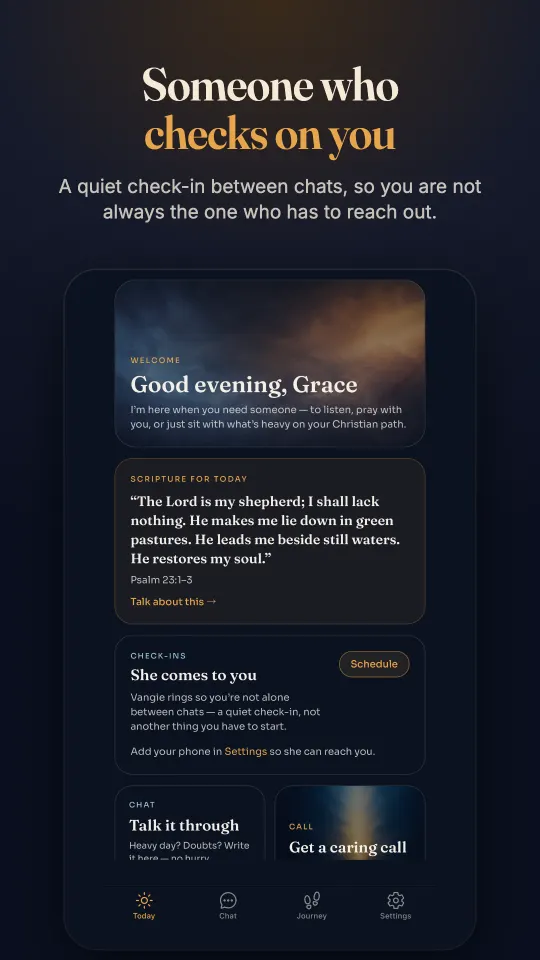
Vangie is an AI faith companion you can talk to any time by chat, or by a gentle phone call that listens first and can end with prayer. Choose Christian as your tradition and she can pray a psalm with you, find a passage that fits what you're carrying, and talk it through; she searches for scripture rather than quoting from memory. She keeps what you're praying for in your Journey, opens each day with a line of scripture on the Today screen, and can call at a time you choose. She isn't a pastor, priest or crisis line, and works best alongside your church and the people around you.
General information, not medical or mental health advice. Vangie is an AI companion: not a licensed counsellor, therapist, doctor or member of the clergy, and not an emergency service. If you are worried about your mental health, talk to your GP or doctor; in the UK, NHS 111 can help if you need urgent help but it isn't an emergency.