
Bible verses and what the Bible says
Psalm 1 meaning, verse by verse
Psalm 1 opens the book of Psalms with a picture of two ways to live: the blessed person who refuses the company and habits of the wicked and delights in God's law, meditating on it day and night, is like a tree planted by streams of water, while the wicked are like chaff the wind blows away.
Psalm 1, the whole psalm
“Blessed is the man who doesn’t walk in the counsel of the wicked, nor stand on the path of sinners, nor sit in the seat of scoffers; but his delight is in the LORD’s law. On his law he meditates day and night.”
Psalm 1:1-2
The blessed person doesn't walk in the counsel of the wicked, stand in the way of sinners or sit in the seat of scoffers, but delights in the LORD's law and meditates on it day and night.
“He will be like a tree planted by the streams of water, that produces its fruit in its season, whose leaf also does not wither. Whatever he does shall prosper.”
Psalm 1:3
The picture of a tree planted by streams of water, fruitful in season, with leaves that don't wither.
“The wicked are not so, but are like the chaff which the wind drives away. Therefore the wicked shall not stand in the judgement, nor sinners in the congregation of the righteous. For the LORD knows the way of the righteous, but the way of the wicked shall perish.”
Psalm 1:4-6
The wicked are like chaff blown by the wind and won't stand in the judgement; the LORD knows the way of the righteous, but the way of the wicked will perish.
Bible quotations are from the World English Bible (British Edition), which is in the public domain.
A prayer you can pray
A prayer from Psalm 1
LORD, plant me by your streams. Give me roots that go down to what lasts, so I stay green when life is dry.
Keep me from drifting into company and habits that pull me away from you. Give me a real delight in your word, morning and night.
Let my life bear fruit in its season, for your sake and for the people around me. Amen.
Why does Psalm 1 matter so much?
Psalm 1 is the front door of the Psalms. Before the laments, the praise and the cries for help, it sets out the basic choice the whole book assumes: which way will you walk? It does this with two images you can remember for life. A tree beside running water has roots that reach a steady supply, so it stays green and fruitful through dry seasons. Chaff, the husk left after threshing, is so light that the wind blows it away. The psalm also notices how drift happens: first you walk alongside, then you stand around, then you sit down and settle in. Its answer is not willpower alone but delight: loving God's teaching enough to keep coming back to it, day and night. That makes Psalm 1 a favourite for new beginnings, graduations, baptisms and anyone starting to read the Bible.
Psalm 1, verse by verse
- 01
Verse 1: walk, stand, sit
Three postures show how we drift: walking along with bad advice, stopping to stand with it, then settling down among those who mock. 'Blessed' means truly happy or well off.
- 02
Verse 2: delight and meditation
The alternative isn't grim rule-keeping but delight. 'Meditate' in Hebrew suggests murmuring over something, turning it over aloud, day and night.
- 03
Verse 3: the tree by the water
Not a wild tree but a planted one, put deliberately by channels of water. Fruit comes in its season, not all at once, and the leaves stay green in dry times.
- 04
Verse 4: chaff
Chaff looks like grain but has nothing inside, and the wind carries it off. The contrast is between a life with roots and a life with no weight.
- 05
Verses 5 and 6: two ways
The psalm ends with destinations. The LORD 'knows' the way of the righteous, a word that means caring attention, not just awareness.
Across traditions
- Jewish
- Psalm 1 opens the book of Tehillim and sets its theme of Torah, God's teaching, as a source of joy. Many readers see it, together with Psalm 2, as the introduction to the whole collection.
- Psalm numbering
- Psalm 1 has the same number in every tradition; the Greek and Latin numbering only starts to differ from Psalm 10 onwards.
- Christian
- Christians read Psalm 1 as a call to daily Scripture and prayer, and Jeremiah 17:7-8 uses the same tree-by-the-water picture for those who trust the LORD.
What tends not to work
Reading verse 3 as a promise that everything you do will make money. Fruit comes in its season, and the psalm is about a rooted life.
Using verse 1 to cut off everyone who doesn't share your faith. It warns against taking your direction from mockers, not against friendship or kindness.
Treating meditation as reading faster. One verse turned over slowly does more than a chapter skimmed.
Common questions
What is the main message of Psalm 1?
There are two ways to live. A life rooted in delight in God's teaching is stable and fruitful, like a well-watered tree; a life without those roots is like chaff that blows away.
Who wrote Psalm 1?
The psalm has no heading or named author. It seems to have been placed first deliberately, as an introduction to the whole book.
What does 'meditate day and night' mean?
To keep returning to God's word through the day, reading it slowly, saying it over to yourself and letting it shape your thinking, rather than reading it once and moving on.
What is chaff?
The dry husks and stalks left when grain is threshed. Farmers tossed the mix into the air and the wind blew the light chaff away while the grain fell back.
Where Vangie fits
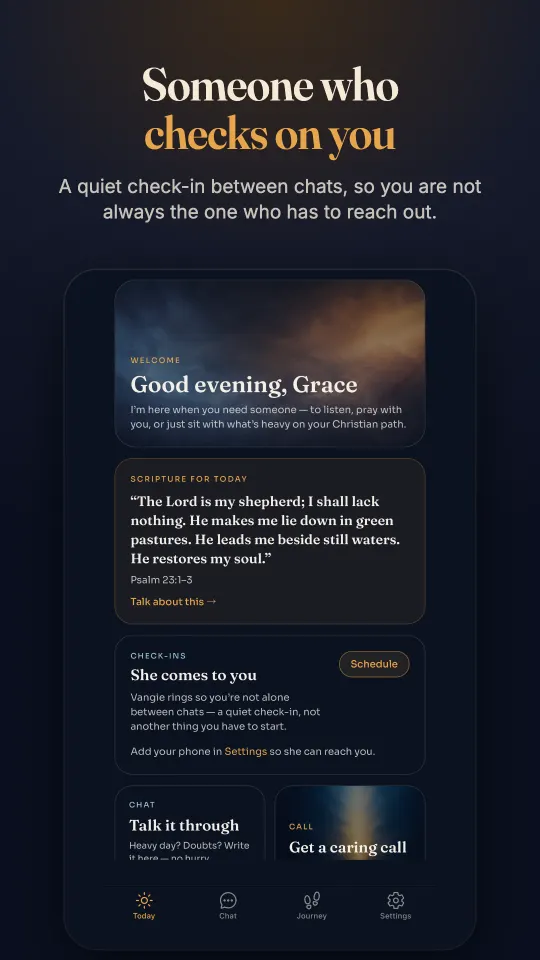
Someone who checks on you
Vangie is an AI faith companion you can talk to any time by chat, or by a gentle phone call that listens first and can end with prayer. Choose Christian as your tradition and she can pray a psalm with you, find a passage that fits what you're carrying, and talk it through; she searches for scripture rather than quoting from memory. She keeps what you're praying for in your Journey, opens each day with a line of scripture on the Today screen, and can call at a time you choose. She isn't a pastor, priest or crisis line, and works best alongside your church and the people around you.
General information, not medical or mental health advice. Vangie is an AI companion: not a licensed counsellor, therapist, doctor or member of the clergy, and not an emergency service. If you are worried about your mental health, talk to your GP or doctor; in the UK, NHS 111 can help if you need urgent help but it isn't an emergency.